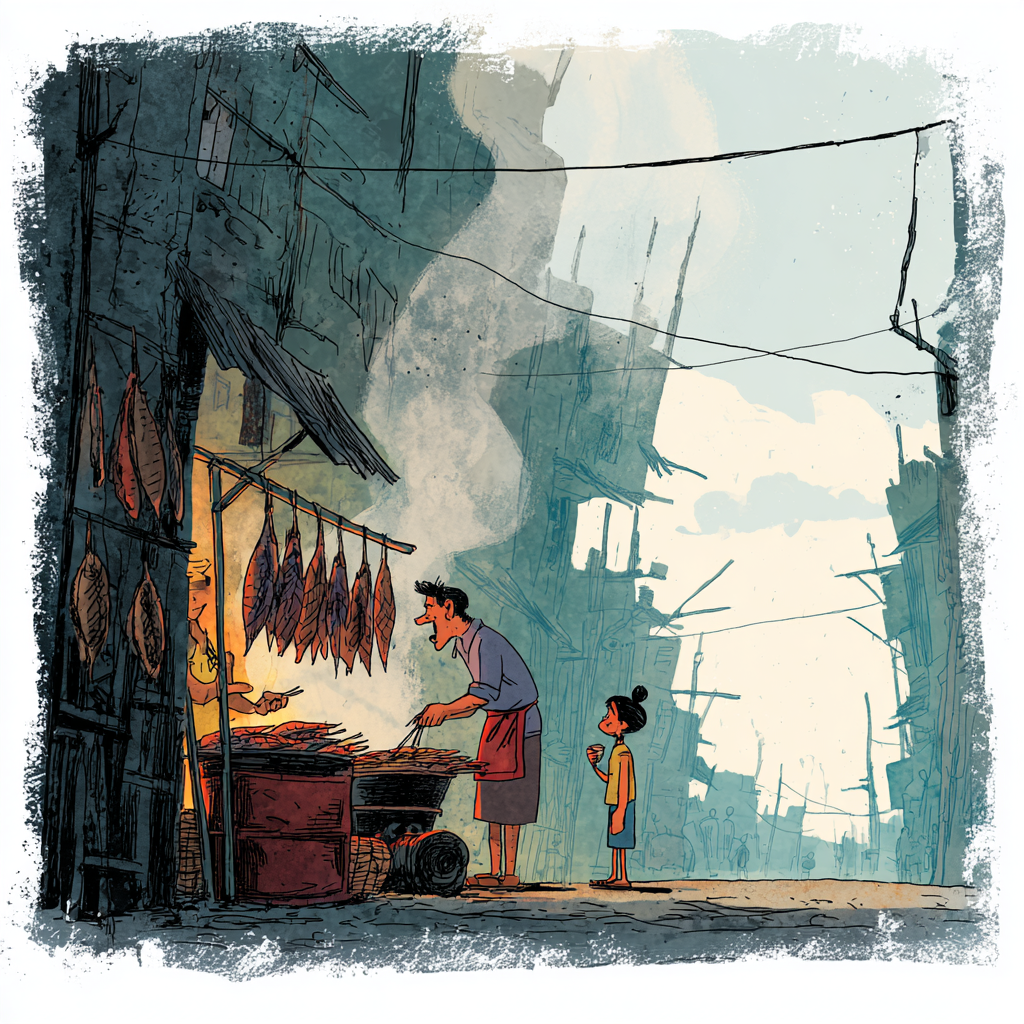

Traditional food preservation sits in the first curl of smoke inside a rusted drum beside the estero. A row of fish hangs from bent wire, thin bodies glinting, eyes already clouded. The man tending the fire does not speak. He lifts a few pieces of coconut husk, feeds the flame until it pulls more smoke, then steps back. Thin smoke. Salty wrists. The air tastes of metal and fish, and the coffee, it hangs on the tongue a beat too long, then a bit more. A baby cries from a nearby house. A tricycle passes, loud, then the road folds back into the soft, working silence.
In school this work receives a clean name, traditional food preservation, as if a chapter heading could hold the smell inside your hair after a day in the smokehouse. Here the names are smaller. Tinapa when fish turns bronze over slow fire. Daing or tuyô when fillets lie under salt and sun until flesh hardens for long storage. Up in the Cordillera, etag or kiniing, pork salted and left to dry above the hearth, skin slowly tanning in the soot. Same verbs. Smoke. Salt. Waiting. Yet each village folds its own weather and wood and worry into the meat.
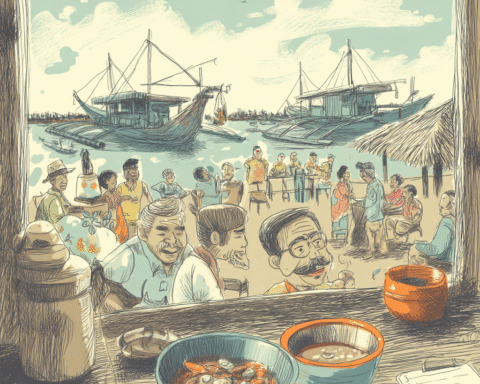
At the shore, before sunrise, women stand over basins where fresh fish slide in heaps, still slick with sea water. Hands move on their own rhythm. Gutting, rinsing, scoring. Rock salt falls in loose handfuls, not measured by scale, but by eye, by seasons of scarcity and plenty. Fish stacks in layers inside blue drums, the brine rising slow. Children weave between bodies, stepping around puddles, taking in a smell they might name only years later. This too is traditional food preservation, although no one here uses that phrase. A radio plays near the back. A joke passes through the group, breaks into laughter, then folds into quiet as everyone bends again over the work. Silence is not absence here. It is concentration, a shared clock.
Higher in the mountains, pork hangs from beams above the fire where rice cooks every day. Thick slabs darken over weeks, fat dripping in soft pops into the ash. Smoke lines the rafters. Dogs lie under the house, noses twitching. Someone once told me this system began with hunting trips, when meat from a single pig or wild game needed to last through weeks of rain. I started to repeat that story as fact, then stopped, because each village traces origin in its own way. The word etag itself feels like a slab on the tongue, heavy, salted, a bit stubborn. In that dark kitchen, time has thickness. Meat keeps one season inside another. Traditional food preservation shifts shape here, from drum and shore to hearth and highland.
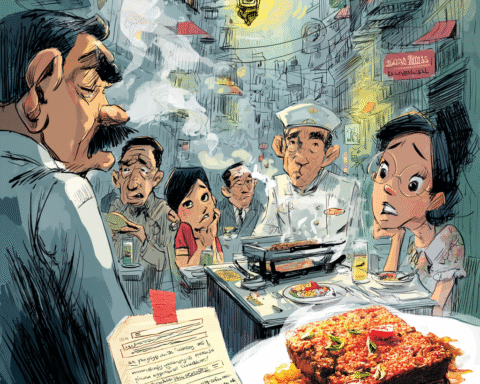
Many city diners still call daing or tuyô food for the poor. Breakfast for hard times, or for the boarding house. Yet a different menu in a Makati restaurant prints “artisanal salted fish” on heavy paper and sets three small pieces beside heirloom rice, a tomato salad, and coffee priced like a kilo of galunggong. Same process, same dry sting in the air when it fries, same crunch at the edge. Two valuations for one method. Traditional food preservation once meant survival, kept protein on the table when the sea turned rough or roads washed out. Now a part of it moves into the language of wellness, of slow food, of “clean ingredients”, even while smokehouses in fishing towns lose space to resorts and warehouses. Contradiction sits in the steam that rises from the same pan.
Industrial language tries to smooth this out. Reports speak of “upgrading facilities” and “mechanical smoking” where fish passes through chambers that burn liquid smoke instead of wood. Standard brine, controlled airflow, predictable output. Traditional food preservation appears in these documents as a category to regulate, or sometimes as a “constraint” on growth. A drum beside an estero does not fit neatly into that table. A smokehouse that leaks through wooden slats offends newer rules on emissions, even when the same smoke built taste for generations. I reach for a neat judgment here and fail. Convenience has its own pull, especially in households where no one has time to tend coals all night.
Inside traditional food preservation sits another lesson that hides behind taste. It is the lesson of slowness on purpose. Fish brines for hours where salt moves slowly into flesh. Pork waits above flame for weeks. A family checks weather before laying fillets on bamboo racks, clouds reading like a second calendar. Each step ties food to place and to time. Miss one turn of the fish under sun and mold creeps in. Rush the smoking and meat keeps a raw center, unsafe. Work moves at the pace of salt, of smoke, of bacteria. Our current schedules keep little space for that sort of clock, which is exactly why it matters. I start to call it slow food, then correct myself. It is simply food that refuses to match a shift schedule from a mall.
When people speak about “saving” these ways, the answer often looks like a festival or a weekend market. A booth with tinapa from Bataan, another with mountain etag sliced for tasting, people taking photos before eating. Traditional food preservation enters as display, complete with tarpaulin, logo, grant. The stallholder explains process to visitors who nod, buy one vacuum-packed piece, then move on. Meanwhile, back in the barangay, a small backyard smokehouse closes after a neighbor complains about smell, or after the younger generation leaves for work in another country. One part of the practice survives as curated symbol. Another part, the daily repetition, the ordinary boredom, slips away almost unseen. We talk about rescue, about documentation, about projects, and then.
Memory holds different details, often smaller. The way your shirt keeps the scent of tinapa all day, even after you step far from the drum. The hiss when salted fish hits hot oil at dawn, neighbors waking through that sound more than any alarm. Heat on the face when you open the lid of a smokehouse, breath catching for a moment, a half cough, a sensory stumble while eyes adjust. I want to say every Filipino knows this smell. Then I pull back, since malls and fast-food chains have rewritten breakfast for many. Still the hands remember. Still the nose remembers. Even in a condo, a small pan of tuyô calls out something older, something larger than one morning’s meal.
If we treat traditional food preservation as heritage, we need to look past display tables and return to labor. To who wakes first to buy fish before ice melts in the styrofoam box. To who cuts wood, who scrubs racks rough with smoke, who accepts aching shoulders as part of the recipe. In mountain kitchens, to who tends fire while also watching children near the same open hearth. Preservation here is less about a finished product and more about a chain of small decisions spread across hours, days, seasons. Some of these decisions will not survive. Others might bend, adapt, move into new forms we barely recognize.
Traditional food preservation will not bring back every shoreline smokehouse or every beam lined with etag. Yet it offers a way to think again about time and work in our meals. The next plate of tinapa or daing on your table carries not only flavor, but also the memory of salt on skin, of wet feet on dawn cement, of loud laughter beside the drum that stood in smoke and silence. To honor that plate is to ask who still practices these techniques, what support they receive, what rules press against their small fires. The smoke drifts upward, then out, hard to catch. The work underneath waits, still warm, for a different kind of attention.