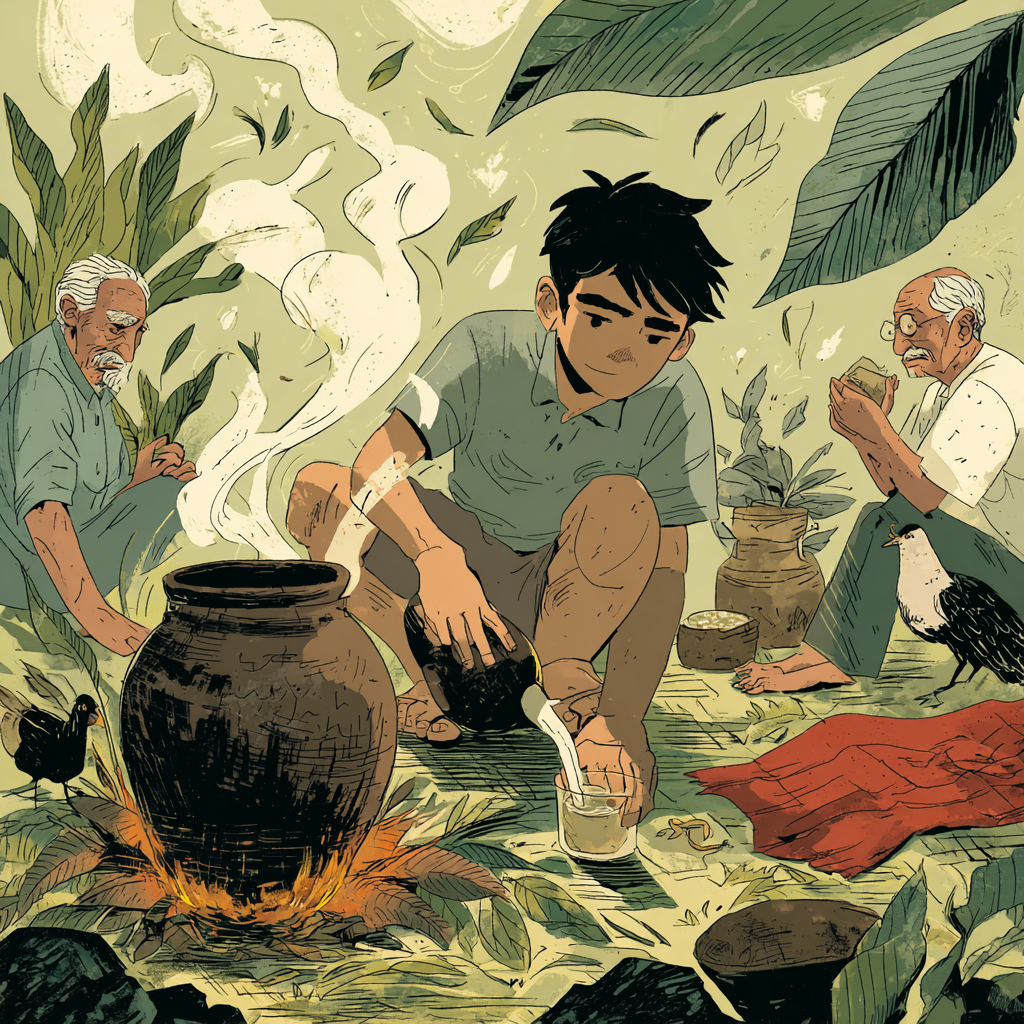
He pours without looking up. The bamboo tube drips slowly. Each drop hits the shell, not loud, but steady. The coconut bowl wobbles slightly in its cradle of ash. The boy leans in, but barely touches it. Just enough to keep the rim level.
Off to one side, an old man reaches for the cup. Both hands, small grip. He doesn’t rush.
The others sit still.
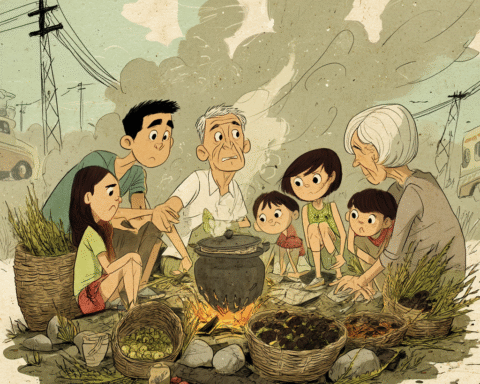
We’re on a clearing outside a low hut in Besao, in the hills of Mountain Province. A fire curls thin smoke behind us. Chickens stalk the edge of the trees. Some cassava leaves hang low over the roof’s side. A large basket rests near the door. Inside, camote, still damp.
Boiled gabi fills the air. So does clay and ash. But there’s something else — fermented fruit, sharper than vinegar, but quieter. The jar near the boy holds tuba, though no one calls it that loud.
Not roadside tuba. No red cap. No sweetness. This one is pale and sour, with a bite that comes up late. They say it sat for two days in a clay jar, sealed under banana bark and covered in leaf mulch. Not for sale. Not for fun. Someone says only if the ancestors are watching. She speaks without facing me. She is looking toward the ridgeline.
The cup moves clockwise, one drinker to the next. Never passed hand to hand. Always set down. The boy does not drink. He folds a cloth and wipes the rim between turns. He pours carefully. He doesn’t look at the people. Just the shell.
Later, someone tells me his role. The taga-apud. The offerer. He watches. He waits. Only pours, unless invited otherwise. His job is more than pouring. He has to notice things.
When I ask what the silence means — the one that sits across the first few rounds — the boy gives a flat answer.
“So no one lies.”
An old man near him lets out one short laugh. “Or says something foolish.”
No one adds to that.
They drink slowly. No rush. When a cup is finished, it’s placed down flat. Not upside down yet. Not yet done. The boy doesn’t need to be told when to refill. He pours when the signal comes. No glance exchanged.
A woman receives a full shell and pauses. She doesn’t drink. She dips a finger inside. Then touches the ground beside her heel. Only after that does she sip.
“For them,” she says. She means the ones not present.
The others stay quiet. One more drink, one more turn.
It isn’t much liquor, they say. It only lowers the noise inside your chest. That’s how someone puts it. Not slurred talk, not raised voices. Just space.
After maybe eight or nine rounds, one of the older men sets his cup mouth-down on the board. Someone else does the same. The pourer stops. The boy returns to the jar and ties the red cloth over the opening. One knot, pulled slow.
Afterward, there is food. Mostly greens. A broth made from river snails and stalks. Boiled eggplant mashed with salt and garlic. Crisped pork skin, just in patches. Nothing rich. No one calls it a feast. But plates are filled.
I ask the woman again, do they drink this at birthdays?
“In town, maybe,” she says. “People drink for any reason.”
Then she looks at the boy. “But that’s not what this is.”
I ask again what this is, then.
Her answer takes a second.
“Learning. But without talking.”
The boy keeps sitting near the jar, even with the drinking done. His hands are on his knees now. But if someone had asked, he’d still be ready to pour.
They used to drink basi here, she says. Sugarcane wine. Boiled syrup aged with bark. More steps, more waiting. But sugarcane grows thinner now. Tuba became easier. The steps shortened. The rules stayed.
I ask what rules.
She turns her hand upward, as if that’s obvious.
“Don’t drink ahead of your elder. Don’t skip them. Don’t touch the jar if no one asked you to.”
The clay jar has a ridge near its neck. Some say it cracked years ago in the cold. Somebody sealed it with resin. Still pours.
They don’t call this a lesson. They don’t explain much.
But the boy sees who drinks first. Who doesn’t take a second. Who lays the shell gently. Who doesn’t wipe the lip. He sees when a round is ready, and when it’s done. No one tells him to watch. He just does.
Someone near the edge stretches their legs and says this year’s batch went down lighter. The bark was cleaner. Or maybe the spirits left earlier. There’s always someone who says that.
The meal slows. The fire dies out near the cassava. Chickens come close again.
The boy stands. He grips the jar under its neck and walks behind the house. No words follow him. No one tells him what to do.
But they all saw him pour.
And one day, someone will wait while he pours again.