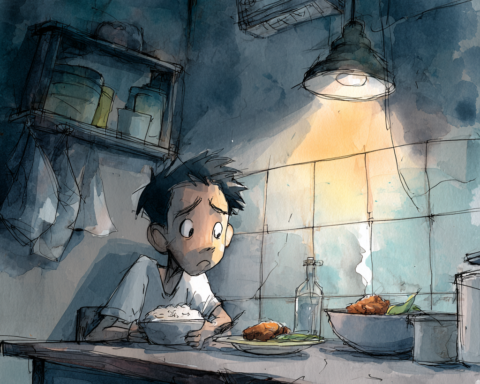
Lena is at the stove her mother used for twenty years in this apartment, and she does not look up, just watches the fat. Behind her at the kitchen table, Bea sits. Her daughter is twenty-three, back from Portland with opinions about fat. A pale scoop of rendered pork fat drops into the hot pan.
“That’s too much,” Bea says.
“I know how much to use,” Lena says.
That is the whole argument. Everything else is the same argument, longer.
Lena’s adobo starts with fat. Brown garlic, then pork. Toyo and cane vinegar next, a pinch of sugar the way Batangas cooks know to add it. The liquid pulls down into a dark glaze. She learned this from her mother in Talisay, measuring nothing. The smell told her when to move. But that mother’s lard came from somewhere specific: not a jar from the wet market but fat rendered off a neighbor’s pig, a backyard breed that no longer survives in the city. That lard tasted of the season, of feed and weather, the particular animal it was, something no jar could hold.
Bea watched this for eighteen years in this kitchen. She also knows what her phone says about saturated fat and sodium and the kind of eating that compounds across decades.
“It’s not about the taste,” Bea says, not to me, to the back of her mother’s head.
“Then eat,” Lena says.
I have stood in kitchens like this before. Patis near the range, a garlic braid above the window. The cast iron pan sits too heavy for anyone who grew up somewhere else, in a kitchen where the instruction was never written, only watched. In these kitchens, fat meant skill. Ginisa comes from the Spanish guisar, which the Tagalog kitchen absorbed along with the onion and the particular logic of starting a dish in fat. Garlic before the meat. The pork lard is older than the colonizers, but the combination, the assumption that flavor begins this way, came from elsewhere. What Lena tips into the pan carries both.
What Bea carries is different. She spent a decade on school lunches that labeled fat the enemy and health classes built around food pyramids. A food culture that discovered Filipino cuisine as a trend told her the lard was the problem, as if you could swap it out and arrive at the same dish.
Portland was where she tried. Pork shoulder, cane vinegar, vegetable oil instead of lard because she could not bring herself to buy the jar from the Asian grocery two blocks away. The adobo looked right and her roommates said it was delicious. She ate it like she was showing someone a photograph instead of introducing them.
Neither of them is entirely wrong about what they know. Bea does not reach for it right away.
“I’m not saying you cook badly,” Bea says. Her voice is lower now. “I worry about you. Your blood pressure and cholesterol. The doctor said—”
“I know what the doctor said.”
“Then—”
“Your lola cooked this way her whole life,” Lena says.
“That’s not how risk works, Ma.”
Lena says nothing to that. She turns back to the stove. Adjusting the heat is easier than answering. I stay out of it. You do not correct either of them, only listen for what lives underneath. From Lena, fidelity to a kitchen her mother ran, a way of reading hunger she learned before she could name it.
The worry is love. Bea just learned to say it somewhere else.
The plate sits between them, cooling.
Filipino daughters reach for patis before table salt even after a year of counting sodium. They know without being told that the garlic should brown past gold, and the adobo is still what they want when sick or sad, specifically, not a substitute. But somewhere between childhood and adulthood, the food their mothers made became complicated in ways that kept shifting.
I ask Bea later, when Lena has stepped outside, if she ever stopped craving it.
“No. That’s the problem.”
She means it as a confession. Something in it lands closer to resolution.
When Lena comes back, Bea is eating, and neither of them says anything. The plate empties. Above the window, the garlic braid hangs where it always has, unchanged from when Lena was Bea’s age and her own mother stood at this stove. Steam fogs the window as the fat in the pan goes quiet.
I finish my own plate. The adobo is what it always is. The vinegar cuts through before the sweetness Batangas kitchens hide inside without announcing it. The lard is there — you can taste every choice Lena made without measuring, and underneath it, faint, the trace of a woman in Talisay who rendered her own fat and whose name most of this table never knew.
Bea sets her fork down. “It’s good,” she says.
Lena picks up the plates. “I know.”