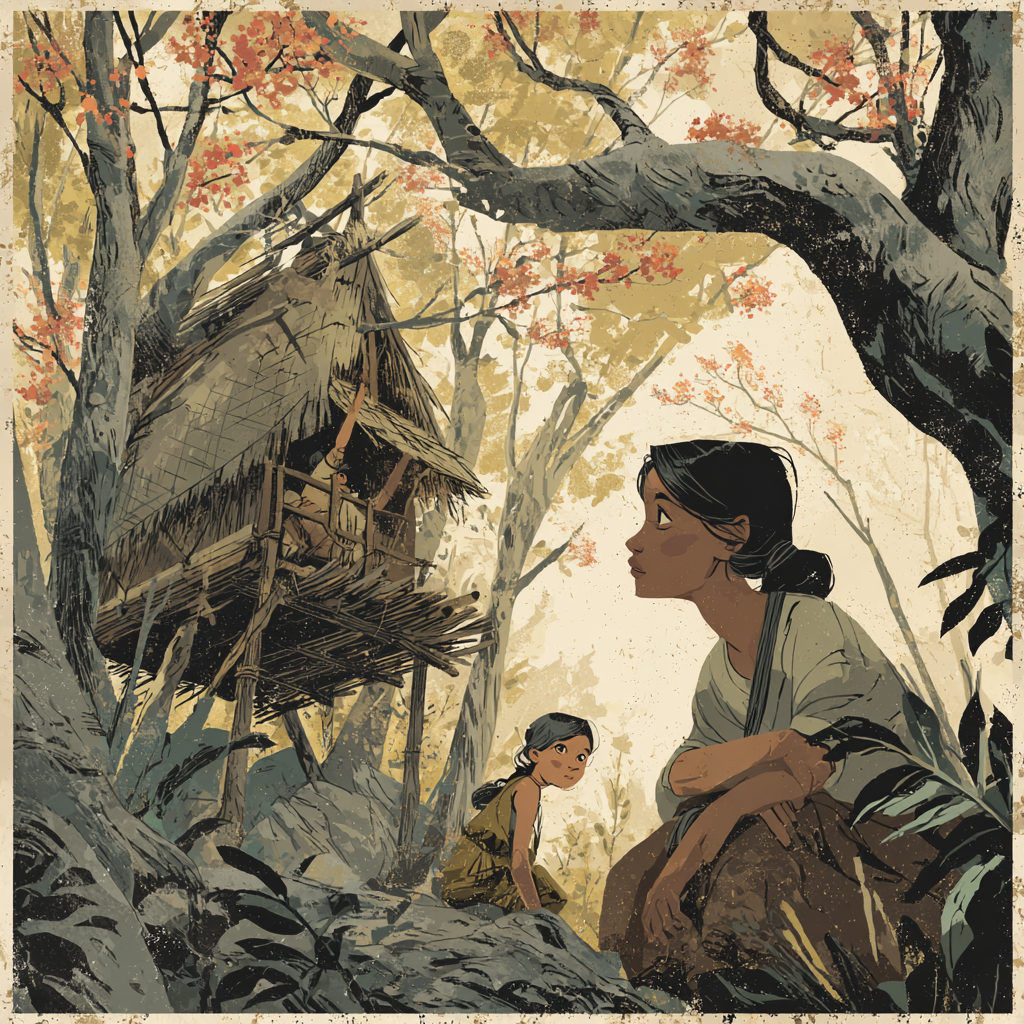

Her hands move through the air. Not pointing. Just… reading. Like she’s touching something invisible. I’m sitting on that bamboo platform. Shirt sticking to my back. Sweat running down where my collarbone sticks out. Can’t name that green smell in the air. Just know it’s there.
She names months by what swells in the soil. Bulaklak ng sampalok. When tamarind flowers burst like rust. Ulan ng pako. When ferns uncurl after the first downpour. Alaas ng puno. When trees shed seeds like tears. Her calendar lives in the tilt of a branch, the color of river water. Not paper. Not numbers.
A girl grinds wild tubers beside her. Head bent over a phone screen. The elder’s knuckles whiten around a pako shoot. “They teach counting in school,” she says. Voice dry as dead bamboo. “Not when the honey runs.” She snaps the shoot. Shoves it toward me. “Taste.”
I bite. Bitterness floods my mouth—clean, violent. My eyes water. She watches my flinch. “Good,” she grunts. “Means no chemicals.” Her finger drags across the fern’s stem. “See this vein? Like a river map. This is how you read time.”
Land has stolen her markers. She points to a bald ridge where lalak trees once stood. “Coffee now,” she says. “Coffee doesn’t breathe with the season.” Her people used to follow fruiting trees for days. Now fences cut the paths. I follow her gaze. See only stumps. Knee’s sore from yesterday. From kneeling on that rock while she showed me the roots.
Climate shifts the signs. Lalak flowers bleed pink weeks early. Rains arrive late, thin. She rubs her temples. “Forest gets confused. We get confused.” Learned from her mother who learned from hers. But the old markers lie now.
A boy drops a basket of yams at her feet. Cuts stripe his forearms. Dirt packed under broken nails. “Four hours today,” he pants. “Some days… nothing.” He holds up empty palms. “Gone. Or taken.”
She rolls a yam between calloused hands. Slices it open. Pale yellow flesh. “This one remembers the deep forest,” she murmurs. Offers a sliver. I chew. Dusty. Nutty. Nothing like the waxy tubers in Manila markets. My throat tightens—not from emotion. From the realness of it. Like eating time.
I ask about the surat Mangyan. The script I’ve seen in archives—elegant swirls on bamboo strips. She scoffs. “Poetry. Love songs.” But then she hesitates. Her granddaughter’s thumb scrolls through a video. A man’s voice recites: “When the tawilis jump high / The bayabas leaves turn dry.” The elder’s eyes sharpen. “That’s not just love,” she says. “That’s when to plant. The tawilis jump before the dry season.” She takes the phone. Rewinds. Listens again. “Hear how he says turn dry? Not fall? Means the leaves stay on the branch. Ready for medicine.” The poetry is the calendar. Written in water and wind.
Deforestation erases the names. She speaks of sagisag—a fruit “round like the moon, purple inside.” Gone now. River bend where it grew is rice paddies. I press: “What did it taste like?” She closes her eyes. “Cold. Like river stones in your mouth. Burst when you bit—sweet blood.” She mimes the motion. “Stained your tongue purple for hours.” I feel it in my ribs: how language dies when land dies. How a taste becomes a ghost.
A younger woman brings boiled cassava. The elder chews slowly. “They say plant more rice. But rice is always rice.” She gestures to the forest. “This changes hour by hour.” Her eyes catch mine. “You feel it? How the air thickens before rain?” I nod. Truth is—I feel only sweat. My wristwatch says 3:15. The forest says batuan season.
Nearby, the girl with the phone lifts it toward the elder. Not to scroll. To record. “Show me again,” she says. The elder’s hands move over imaginary vines. “Like this,” she says. “The pako curls tight when the rains come late.” The girl nods. “Good,” the elder says. “Now you have it.” The phone isn’t a distraction. It’s a new surat. A vessel.
A man arrives with bayabas leaves. Freshly picked. Still damp. She inspects one with a caterpillar hole. Smiles. “Good,” she says. “Means no chemicals.” Holds it up. “See the pattern? Not random. This shape”—she traces a spiral—”means the dilim season. When the forest eats its own shadows.” She turns the leaf. “This hole? Made by the tandikan moth. Only comes when the lalak flowers early. Like now.” The imperfection isn’t damage. It’s a sentence. Written in hunger.
Sun dips. Shadows stretch long as hunger. The elder rises. Points to a lone batuan tree. Branches heavy with green fruit. “Time for sour soup,” she says. Plucks one. Squeezes. Juice stings my nostrils—sharp as a snapped twig. “When this ripens,” she murmurs, “river fish grow fat.” She tucks it into her wrap. “For soup tonight.”
I notice then: the tree stands alone. Stumps circle it like broken teeth. She sees me looking. “One tree can’t keep the calendar,” she says. “Need many trees. Many signs.” Her voice cracks. Not weakness. Grief like a snapped root.
As I leave, she calls after me: “Tell them the forest has its own clock. Not the one they made.”
Bus stop. I pull out the fruit.
Almost didn’t see it. That tiny green thing pushing through the cracked skin. Cupped it in my palms. Felt it. Something stubborn. Something that wouldn’t quit.
Took it to that little garden near my place. The one with the broken fence.
Covered it up. Soil felt wrong. Too hard. Like it had concrete mixed in.
Days pass. The shoot doesn’t grow. Doesn’t die either. Just hangs on. Waiting.
When I visit the mountain again, I bring the pot. The elder examines it. Nods. “Good,” she says. “Not dead.” She takes it to her hut. Plants it near her doorway. “Needs forest soil,” she explains. “Needs forest air.”
Girl was filming it with her phone. Just held it up. Didn’t say anything.
Leaving again. She pressed something into my hand. Didn’t look at what it was. Just closed my fingers around it.
The bus pulls away. I look back. See the elder standing where the forest meets the road. One foot in each world. Her hands moving through the air. Reading the invisible lines. Keeping time.