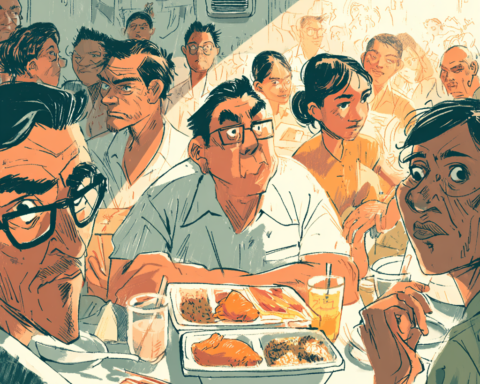
Digital food culture sits on the table before rice lands. Phones rest beside spoons, screens dark for now. Plates land with a small clatter. Garlic smell hits first, heavy, then a faint sweetness I mistake for soy before it slips into something I fail to name. Someone reaches for a spoon and stops halfway. Hand hanging, unsure where to go. The first tap on glass breaks the pause, and the table slides into a small stage.
On our old table in Pampanga, hands moved in one direction only. From serving bowl to plate to mouth. One frame on the wall held a stiff wedding picture, faces formal, story patchy. The table held tinola drifting toward lukewarm, enamel plates with chipped blue rims, rice pressed into small hills by quick wrists. A cup of patis and calamansi sat near my lola’s elbow. Conversation first, then spoon, then more rice. No one rearranged garnish for a lens. I like to say the past felt simpler, cleaner. That line flatters the storyteller more than the house. Grease on the floor, smoke in the curtains, old quarrels breaking out between servings. Memory edits for comfort.
Inside cafés and ramen places, a bowl arrives and people adjust themselves. A friend stands to dodge a shadow. Another slides a glass two finger widths to the right so light hits the rim. Someone asks the server to wait before topping off water. Instagram food photography wants height, shine, room. The broth smells burnt at the edge, then like toasted garlic, then shifts again and my nose loses track. A spoon dips in and stops while a hand angles the phone. A small crowd forms around a dish no one has tasted. For a short time the food belongs more to the camera than to the bodies seated around it.
In Manila, gutom once pointed straight to an empty stomach. Jeepney rides at noon with traffic frozen and sweat sliding down the back. Baon packed in old ice cream tubs, thin adobo sauce pooled at the corner. Crackers shared between cousins on a plastic chair, no witness except the people eating. Today #gutom moves across feeds as complaint and performance. A selfie beside a tower of fries and wings, caption insists on hunger while the table strains. Digital food culture in the Philippines stretches that word until it covers stomach, mood, boredom, pride. Mukbang videos glow on screens, a stranger somewhere else empties packets of noodles for thousands of viewers who eat and do not eat along with them. Full and not full. Present and oddly removed.
Street corners feel this shift in slower ways. The fishball vendor at the kanto has worked the same kawali for years, arms moving in practiced circles. Before, the line formed, sticks dipped into the big jar of vinegar, stories traded while oil spat. No record. No filter. Today a student asks him to pause so she can lean in with her phone. She asks him to dip one fishball closer to the surface, slow, so the sizzle shows on video. The jar of vinegar moves forward into the frame. A stick of kwek kwek rises against a pink evening sky for a short clip that disappears in a day. Filipino food on social media looks tidy, bright, without the dark stains on the pavement where oil fell during rush hour. The air near the cart stays thick with fry smoke and exhaust. The hand that stirs the pan slides almost out of the picture. Background to its own work.
Inside malls, rice learns a new role. A plate of sisig arrives on a hot skillet that hisses louder than the room. The flame jumps higher than needed so someone records it. Staff turn plates so logos face the lens. Neon words hang on walls for backdrops. Jars, plants, small props line every shelf. Digital food culture pushes menus sideways. Less of the big metal pot at the back refilled all day, more of the single dish with a clean edge that looks sharp from above. This is how social media changes eating, in details that feel minor while they happen. Seasoning shifts a little toward appearance, away from slow comfort. No hero here, no clear enemy, only many quiet decisions pulled toward what photographs well.
I tell people I eat first and forget to take photos. I say it with small pride. Then I open my gallery. A grid of plates fills the screen. Tapsilog beside iced coffee, adobo under low light, a bowl of soup whose name I no longer recall. I scroll and scroll. Another row, then another. Some shots appear in sets of three, same dish, fork moved slightly, tissue folded better, reflection removed from the spoon. I once claimed these were for memory, a simple record. The pattern answers me. Hearts and comments waited at the back of the decision, quiet yet firm. I fed my feed, then my hunger. That order reverses the story I tell.
On a shelf in my parents’ house, my lola’s recipe notebook sags a little to one side. The cover smells like old paper and faint oil. Pages cling together on humid afternoons. On one line, kansi sits between slow loops of blue ink, measurements loose, full of “konti,” “tantsa,” “tikim.” No date. No tag. No map of where the dish came from. In the margin, brown spots where broth once spilled and dried. Digital food culture offers something different: folders of clear photos, shared recipe posts, backups sitting in the cloud, safe from floods and termites. I start to say this feels better, safer, like progress, then stop halfway through the thought. The files stay sharp, yes, yet they hold no weight, no smell, no brittle patch where soup once soaked through a page. A recipe turns into numbers and steps. A plate turns into pixels. The old notebook turns into clutter many homes throw out.
One night in Mandaluyong, I lean over a bowl of goto in a small shop near an MRT pillar. Plastic chairs, uneven floor, bright lights. The tripe hits my nose hard, almost sour, then steam climbs and softens it, then wakes again when ginger rises and I stir without thinking. I lose count of the changes. My tongue stays a step behind. Across from me my friend lifts her phone, then freezes. Her thumb sits on the camera icon without pressing. The phone goes back down. “Later,” she says, voice small, not sure who she speaks to. We eat. Metal spoons knock around the bowl. Rice and broth stick together, heavy on the tongue. Ginger hits late and a bit hard at the back of the throat. When we finish the bowl leaves a dull ring on the wood, a pale sticky mark the staff wipes off without looking. No evidence, no post, nothing to scroll back to. Still, that small move lodges in my mind. I start to say it means we are changing, then the words thin out before they settle. The feed flows on with its own rhythm while rice and broth and tripe stay in the body, stubborn, long after signal fades.