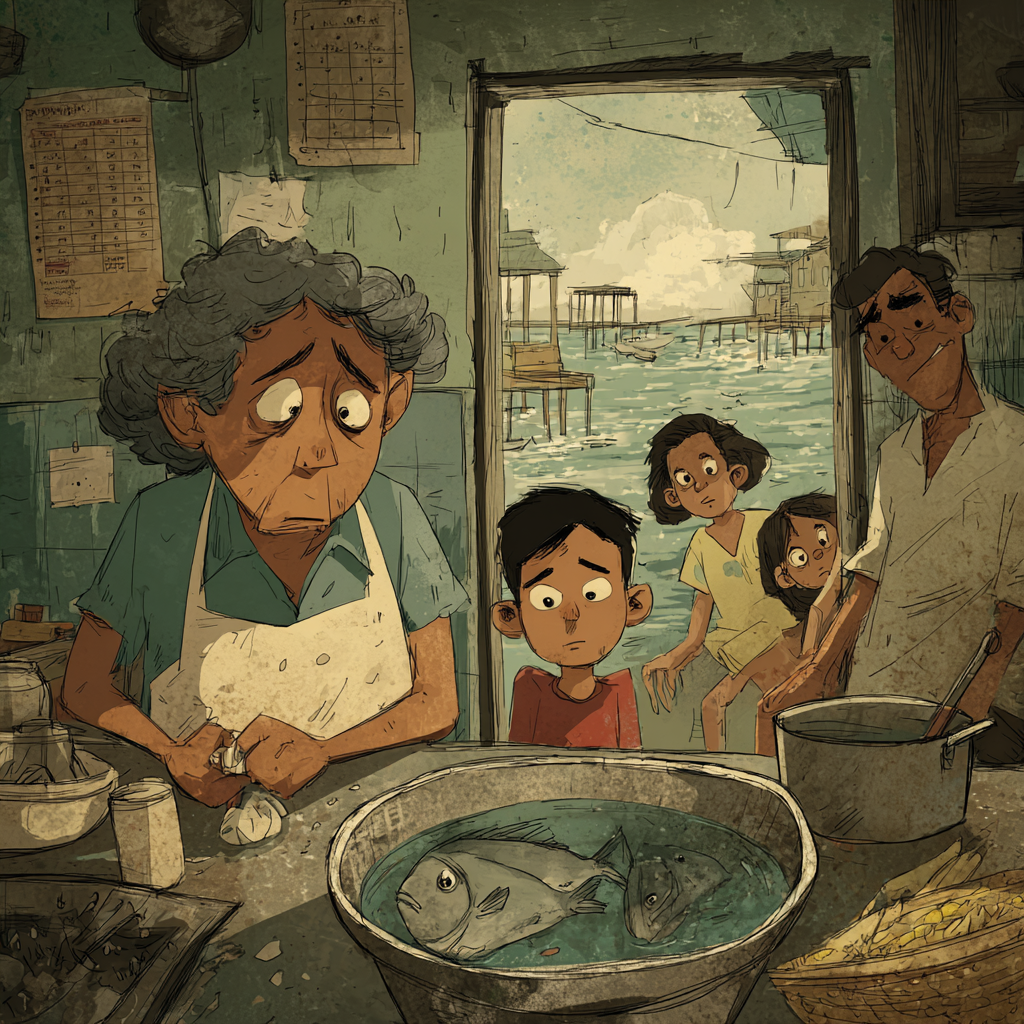

Philippine freshwater fish once lay in a dented palanggana on my lola’s bamboo table. Small fish. Silver, twitching, the eyes still bright from the river. The smell was sharp with mud and, no, not rotten, only thick, like wet earth held too close to the nose. On the floor, the river stones she used to descale ayungin waited in a shallow basin, slick and cold. Someone outside shouted about the water rising again. Someone else laughed it off.
She worked fast. A thumb in the gills, a knife along the belly, one clean pull. Not so clean, I remember now. Scales flew in a messy spray, stuck to her forearms and to the blue plastic apron with a cartoon banana faded at the edges. She would say the names as she worked, almost like a roll call: dalag, ayungin, biya, kanduli. I thought they were only sounds. Not a list of a place. Not yet.
We said the river was already dirty at that time, and still we swam in it after lunch, still we swallowed a little of the brown water whenever someone pushed another cousin off the banca. My aunt would warn us about the water, about what washed down from upstream, about… then she would stop and look at the fish on the table and decide not to finish. Contradiction lived there in one kitchen. In one floodplain.
Years moved. The riverbed in that town grew shallower and wide. The water slowed. Plastic bags snagged on the roots of kangkong, and the occasional slipper did its own slow journey downstream. My lola’s palanggana stayed, scratched metal now, but the fish inside changed. More tilapia from cages in the big reservoir. More frozen bangus from somewhere far, somewhere I could not place on a map. Less of the slippery, wild bodies that carried the taste of that one river bend behind the market.
The old names shrank on the plate. Ayungin came smaller, less often, and then not at all. Relatives said, almost casually, it was harder to catch. Nets came up light. Indigenous freshwater fish across the Philippines have been pushed down by overfishing, dirtier water, silt, illegal gear, invasive neighbors, and climate shifts, according to fisheries officials. A long sentence for what we first felt as a shorter serving. A thinner broth.
In other parts of the country, fishers around Laguna de Bay talk about how native dalag, ayungin, and talilong grew rare in their catch, while knifefish, a foreign arrival, showed up in frightening numbers. The pattern feels familiar even if the exact fish differ. First the water grows crowded with silt and algae. Then new species arrive through stocking, trade, or accident. Then the old river dishes lose their central character and slowly slip out of daily cooking. No big ceremony. They only get cooked less this month, less this year. Until the recipe stays but the ingredient does not.
In Pasig, once a working food river for Manila, observers already worried about pollution in the 1930s, as fish movement between the river and Laguna de Bay changed. By the 1990s, the river was widely described as “biologically dead,” even as later reports showed bits of life returning in the form of tilapia and hardy species, along with warnings not to eat them because of contamination. Death, then a strange afterlife. Fish present, yet not food. From the bridge it still looks like any other river, brown and restless. On the tongue, though, the taste slips away fast, a thin metallic trace, a wrong soap note at the end.
Researchers list around sixty introduced freshwater fish species in Philippine waters. Many entered through aquaculture projects, some through aquarium trade, others tagged to weekend sport at lakeside resorts. On the plate this turns into a quiet standardization. Tilapia fillet under orange sweet-sour sauce, the color of bottled mix. Farmed catfish fried whole, thick crust, oil pooling at the tail. Safe, predictable, sometimes affordable, yes. I refuse to pretend these dishes do not help in a country where protein prices fight with rent. Yet the result at the tongue is that rivers from Luzon to Mindanao start to taste more alike, even while their actual water stories pull farther apart.
My lola’s sinigang used to depend on what the river felt like that week. Kanduli for one pot, with guava and long strips of mustasa. Biya for another, lighter, with kangkong snapped by hand. She would sip the broth, stop, wrinkle her nose, then reach for one more handful of river salt with wet fingers. The sourness came first in a rush, the fat from the fish following in uneven patches, and a small bitterness from the greens clinging at the back of the tongue. The sequence sat in the mouth like a map, a rough one, lines smudged by steam. I remember one bowl years later that tasted faint, then no, not faint, only tired, as if the fish lived its whole life in still water.
It might have been ten ayungin in the dish that I keep replaying. Or twelve. I tell myself I will count them in the memory and then lose track halfway, distracted by the glint of their skin and the sound of a tricycle passing outside the open window. This is how disappearance works in food. You miss the number first. Then the name. Then everything blurs into “fish.” We say, “Masarap pa rin naman, isda pa rin.” It is still good, it is still fish, we say it twice to reassure ourselves.
Traditional river dishes once linked families not only to a generic idea of countryside, but to actual bends and crossings. Sinigang na kanduli sa bayabas from a Cagayan tributary speaks differently from pesa cooked with dalag from a Bulacan canal, even if the sour notes align. When the water turns brown with industrial waste, or when a dam cuts off spawning runs and slows the river to a lake, the recipes sit in handwritten notebooks and community cookbooks while the key fish no longer shows up at the palengke stall. The line between ecology and cuisine turns out short. Shorter than a river barangay to the national highway.
You see this when you sit in a city restaurant that markets “heritage river fish” on a laminated menu. The plate arrives. The garnish sits careful, the lighting flattering. The staff speak of authenticity, of going back to our roots, while the fillet on the plate likely comes from a cage in a dam or from a farm pond miles away from any wild river current. Somewhere in the country, fisherfolk around lakes and rivers face water pollution, fish kills, and shifting weather. Somewhere else, an urban diner tastes the safe, cleaned-up, renamed version. Same word “river,” different water.
Philippine freshwater fish once gave each valley and town a quiet accent. The way a Gapan tinola spoke of dalag while an Agusan stew folded in lake sardines from tawilis relatives or their own lake species. Now the accent thins in some places. In others, community efforts set up freshwater fish sanctuaries, limit gear, and push back against destructive fishing, trying to hold on to what remains for both food and income. The country carries both stories at once. Loss in one river, stubborn tending in another.
I think of my lola’s hands when I read studies and policy briefs. The way her fingers knew where to press along the spine so the flesh would open for stuffing with tomatoes and onions. I try to match the technical phrases to her movements. Habitat degradation. Stocking density. Non-native introduction. They sit oddly next to the memory of her rinsing the fish quickly in water pulled in a timba from the same river that fed them. I want a cleaner timeline in my head, when everything shifted, the exact year, the exact flood, yet the change smears across decades. Not one disaster. A pile of small decisions, small conveniences.
The river behind her house still runs, in a reduced way. More like a wide canal in the dry months. When I visit, the children hear they should not swim. There are still fish, people say, but different, and not many. A neighbor’s son holds up a tilapia once and asks me if we had this when we were small. I start to answer and stop. We did, but not like this. Not as the only story. I tell him instead about ayungin and he shrugs, uninterested in a name without a body to go with it. The conversation hangs there between us, unfinished, like a pot taken off the fire too early.
If the river stopped running in memory before it slowed on the ground, perhaps the task now sits with those who still cook. To say the old names out loud in the kitchen even when the substitute fish lies on the chopping board. To remember which dishes came from river bends, from floodplains, from marshy rice edges. To listen when fishers talk about water quality, not as background noise but as recipe history. The taste of one place will not return in full, and I do not know if my tongue recalls it cleanly, yet the act of naming Philippine freshwater fish in full, stubborn detail already keeps a little of that river moving. Not the whole river. Not anymore. Still, moving.