
Luz burned her first bird. Trusted the scent too early. Skin curled, fat hissed, and she thought it was done. Bit in, found blood.
“He made me eat the whole thing,” she says.
She means her grandfather, Tatang Ando. He didn’t say a word, just set the ruined bird on a leaf and watched her chew. She was thirteen.
“That’s how we learn here.”
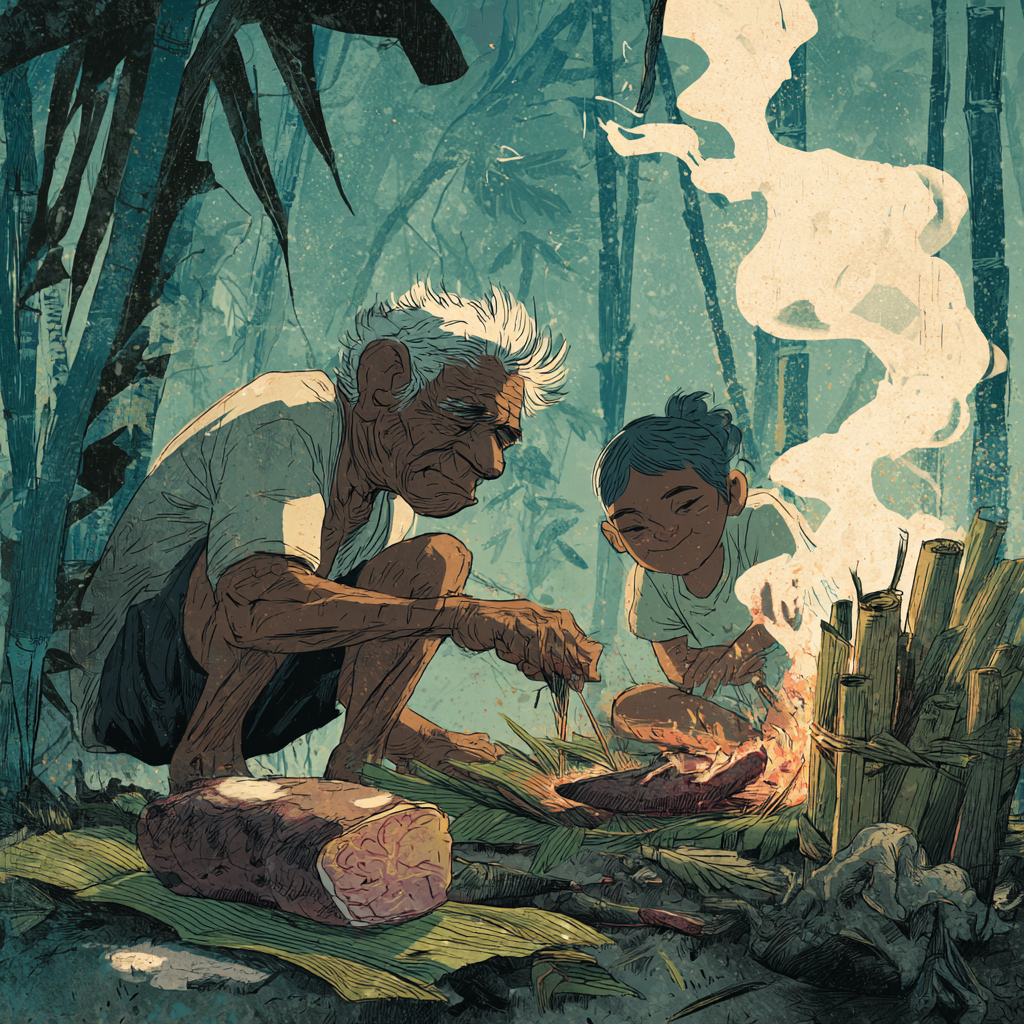
We’re in the hills of Zambales. A clearing blackened from years of fires. Boar ribs rest on a bamboo rack above low smoke. Alongside, rough-cut lizard strips. Two birds.
“He watches the smoke,” she says. “Not the meat.”
Tatang crouches close, kneecaps high, eyes level with the fire. His hand hovers, palm down, then flips—feeling for heat.
“Too fast and the meat lies,” he says.
Luz checks the birds. One of them looks ready—skin tightening just right at the joint. She bends close, pulls back quick.
“Bird is lying,” she mutters. “Still old trickster.”
She’s learned not to trust the first sweet scent.
Her test now is color at the joint. How the skin hangs. Direction of the smoke.
She flips a slice with a folded leaf.
“This one was okay. Fire told the truth.”
There’s no recipe. No chart. You get it wrong, you eat it anyway.
“You can’t ask if it’s ready,” she says. “You just know. Or don’t. Then find out through chewing.”
These are her lessons. Correction through error. If she pulls meat too soon or lets it dry too far, she doesn’t get scolded. She just gets fed the mistake.
Tatang used to dry full slabs of meat for days—boar smoked down till it would carry through rain. They still prep bundles for travel now: one for the road, one for the evening fire. Luz does most of the folding. She knows the wraps. She still guesses wrong sometimes.
“He only shows you once,” she says. “If you didn’t catch it, that’s on you.”
She knows maybe half of what he does. Reads some of the smoke. Hears certain drips. Fat behaves differently when the fire’s too thin.
“He’ll say if the whole thing’s about to fail,” she adds. “But if you’re close? He waits.”
That’s the fragile point—not the food, but the instruction. It’s not that it can’t be taught. It’s that it isn’t. Not in words.
“Festivals talk about us,” she says, wrapping another strip. “But no one eats what’s made there.”
I ask what she means.
“The meat at festivals gets cold on the table. Looks right, tastes like nothing. Because no one who made it learned by burning.”
That’s her complaint—not that people try, but that they mistake performance for transmission. Knowledge doesn’t live in display. It lives in repetition. In failure. In the wrist.
I ask who else her age still learns this.
“They all want fast,” she says. “Gas, button cookers, portable stuff. Easy to watch, easier to forget.” She shrugs.
A scar near her thumb from a misjudged spit rod. She folds a finished strip into a banana leaf and ties it with stripped vine.
Sometimes they call it yung pinausukan kahapon—the smoked one from yesterday. More often it’s just kain na. A name isn’t the point.
When I ask what happens when Tatang stops showing her:
“That’s it. No do-over.”
There are signs she still can’t read—fat that turns sour too early, sap that catches fire the wrong way. She’ll only learn them by doing.
“I wouldn’t teach someone by explaining,” she says. “I’d make them mess up. Then make them eat it.”
She finishes the last fold. Two bundles. One to carry. One to eat.
The fire stays low.
She lowers her hand above the last bird.
Waits between knowledge and guessing.