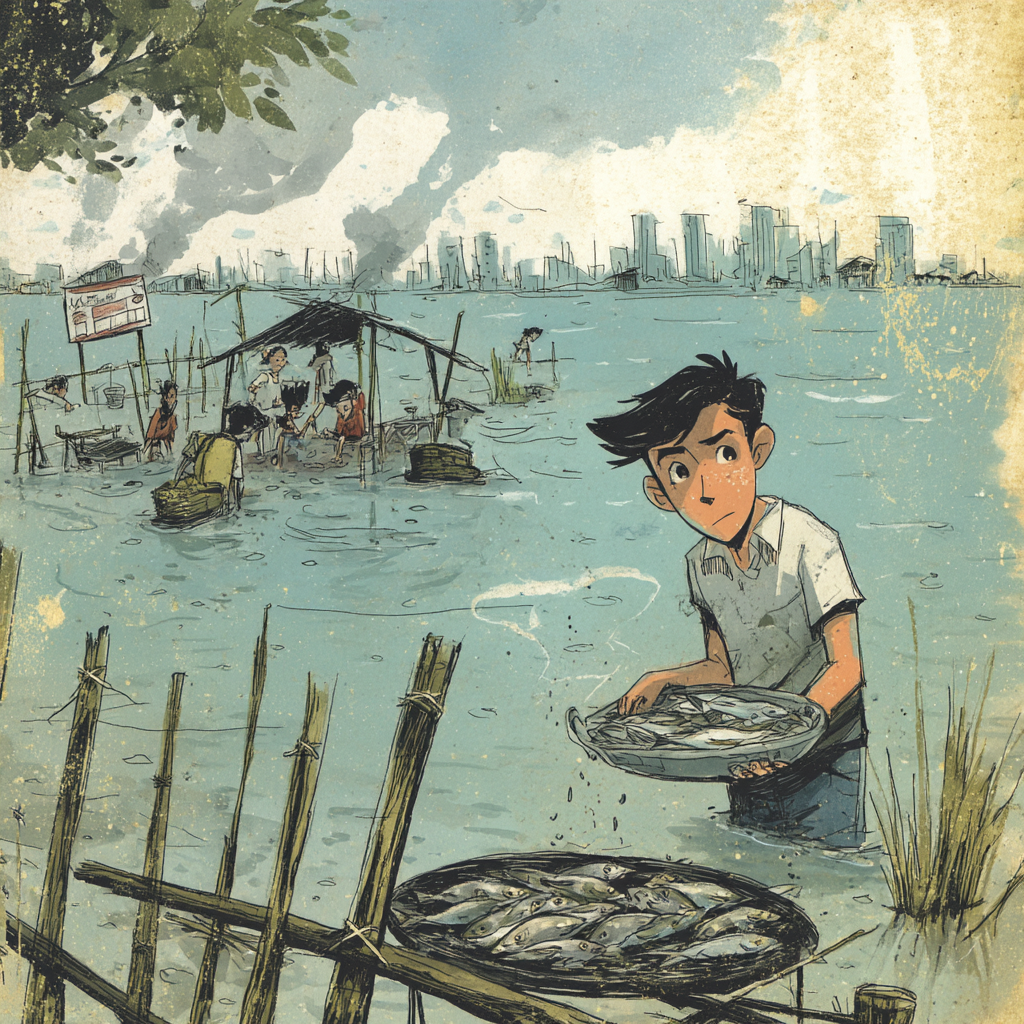

At the edge of the pond, a boy waits with a blue plastic palanggana, bare feet on damp soil. In front of him, water curls higher against the bamboo of the dike. Men in shorts stand hip deep in the pond, lifting a sagging net heavy with sound rather than sight, the slap of tails against rope and skin. At the edge, the boy leans forward, ready for the first flopping bangus, salt on his lips, though the pond was once fresh. This quiet scene of bangus aquaculture feels ordinary, almost dull. The water tells a sharper story.
Old fishpond caretakers remember when this land held palay. The word parilya in the family stories referred first to drying palay on woven mats, then later to grilling bangus over charcoal. Fields near the shore turned into ponds under Spanish friars, then under Filipino landowners, each generation moving a little closer to the sea in search of income. In the late twentieth century, bangus aquaculture offered steady work, simple technology, and a fish beloved from breakfast to fiesta buffet. The conversion spread along the edges of Luzon, Panay, Mindanao, wherever flat land met tidal flow.
The balance felt clear. The sea entered the pond in a measured rhythm through a gate. The caretaker read the moon, wind, and color of the water, then opened or closed the boards. Too much water and the dike weakened. Too little and the fish grew thin. Labor, season, and tide aligned around a fish that tasted of home whether served as sinigang, daing, or relleno. City eaters thought of bangus as bonier, cheaper cousin of salmon. The pond worker thought of school fees, a sack of rice, and the arrival of fry traders in the dark.
Now the gate still stands, but the sea arrives uninvited. Saltwater creeps under and around the boards, through cracks in foundations never designed for constant pressure. Where caretakers once worried only about the top of the dike, they now inspect the base, where water seeps through soil. In some barangays, ponds flood from behind, as higher tides climb through drainage canals and spill into low-lying grids. Bangus aquaculture depends on the thin line between brackish and fresh. Rising seas press that line inland, past ponds, toward wells and rice fields. The boundary grows less certain.
Pond salinity once followed a familiar pattern. After the rains, the water turned softer, the green of algae shifted, and caretakers adjusted feeding. During dry months, the sun thickened the water and farmers drew in more from the sea. Today stories along the coast speak of strange seasons. Heavy rain arrives, yet the water in the pond still tastes harsh, like seawater held too long in the mouth. On some days, the tide seems to push straight through storm runoff. On others, coastal roads flood even without rain, as if the moon reached farther into the land.
In this unsettled rhythm, bangus aquaculture meets new risks. Higher salinity often stresses fry and shortens growing cycles. Stronger tidal surges threaten dikes that hold entire household economies. When ponds collapse or turn too saline, owners shift to other species or abandon fields altogether. Some invest in higher dikes, more concrete, bigger pumps. Others sell out to developers who raise buildings on land once layered with rice stubble, then pond muck, then salt. The old partnership between caretaker and tide weakens under decisions made far from the shoreline, where people speak of emissions and energy instead of feed and fry.
The city appetite for bangus stays steady. Supermarket fillets sit under cold light, deboned, marinated, wrapped in plastic. The label describes milkfish in neutral language, far from the reality of floodwater and brine. When a family in Quezon City picks up a kilo for Sunday breakfast, the story on the plate includes reinforced dikes, salt creeping into groundwater, and mangroves lost to earlier waves of pond construction. Bangus aquaculture responds to demand from inland tables, yet at the same time deepens the exposure of coasts that now face higher and warmer seas.
There is a quiet irony in salt returning to land once wrestled from the tide. The first fishpond builders claimed the edge of the sea for food. Their work thinned mangrove roots that softened storm surge and filtered water. Later, the same ponds became symbols of rural progress, sources of school tuition, proof of diligence. Today, climate reports speak in millimeters of sea level rise per year, while pond caretakers mark the change in shorter steps: the extra plank added to a gate, the new waterline on concrete, the neighbor who moves inland after yet another flood.
At the dinner table, these stories rarely rise with the steam from sinigang na bangus. Children pick at bones, parents argue about politics or phone bills, grandparents shrug at the familiar taste of sour broth and fish fat. The link between this household scene and the distant pond appears only in fragments. A relative in Pangasinan mentions stronger habagat winds. A news photo shows a flooded coastal road lined with idle tricycles. The phrase pagtaas ng dagat floats through conversation, an abstraction until salt reaches a backyard hand pump or a cemetery by the shore.
Yet each forkful holds that mixture of land and sea which feeds the Filipino sense of home. Bangus aquaculture now sits inside a tighter space, squeezed between a rising ocean and an inland plain that also struggles with heat and drought. To taste bangus in the years ahead is to accept not only tradition but also a shared responsibility for the shorelines that supply it. The question rests quietly under the morning mist of the ponds, under the supermarket light, under the oil that pops in the kitchen pan. How much salt will the fields absorb so we continue to eat this fish in comfort.