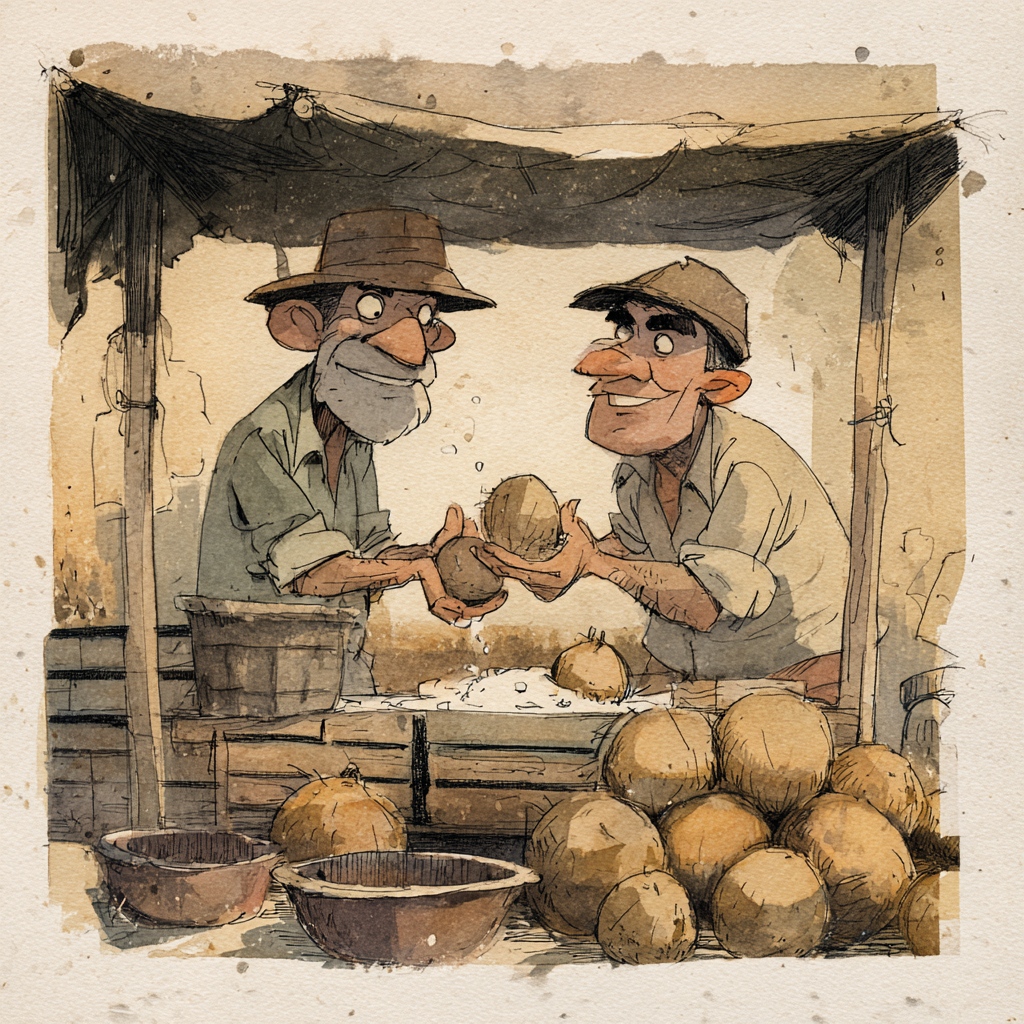
The vendor splits a coconut with a machete. One clean strike. The sound echoes in the humid air of Divisoria market. She offers me the half. White flesh glistening under the morning sun. Sweet, earthy smell.
She says the nuts are smaller now. Less milk inside. “Before, one coconut filled two cups. Now, barely one.” Her hands show the difference. Her calloused fingers draw a line in the air. Sweat beads on her forehead. Wiped away. The heat already heavy at nine.
Ask her how long. She shrugs. “Since the heat got mean.” Her mother sold coconuts here. Her lola too. They knew the trees. Knew when to harvest. But the trees don’t listen anymore. She remembers her mother’s words: “Gata should flow like river after rain.” Now it trickles.
I watch her squeeze grated meat through cloth. Milk drips slow into a bowl. Thick, yes. But not like before. She dips a finger, tastes. “Not enough,” she murmurs. In her stall, coconuts sit in a low pile. Not the usual mountain. Prices up fifteen percent this year. She sees customers walk away. “They think it’s cheap to skip,” she says. But coconut is everywhere. In sinigang. In kare-kare. In the rice cakes at dawn.
Heat stress. That’s what the experts call it. Coconut trees need rain. Need cool nights. Now the days burn. Nights stay warm. Trees get tired. Fewer nuts. Smaller nuts. The Philippine Coconut Authority says yields dropped twenty percent in Bicol last year. Farmers there call it “the silent blight.” No bug. No disease. Just heat.
In Bicol, I met Mang Pedro. His farm has eighty trees. Used to give two hundred nuts a week. Now, one hundred twenty. He shows me a young tree. Brown leaves. He touches one. “Thirsty,” he says. He points to the sky. “No rain comes when it should.” He tells me about Bicol Express. His wife cooks it Sundays. Pork swimming in coconut milk. Chilies burning red. “Now she uses less meat. Less chili. To make the gata last.”
Back in the market, the vendor grates coconut by hand. The rasp of metal against flesh. Grating fast. But the pile stays small. She talks about before. Coconuts cheap as rain. Loyal customers got extras. Free. Now every nut counts. She shows me a nut with cracks. “Heat does this,” she says. “Weakens the shell.”
A man stops to buy. He asks for two. She hands them over. He pays. No words. After he’s gone, she whispers: “Cook.” She watches him go. “They’re the last ones buying. Even they cut back.”
In Quezon City, Chef Ana uses coconut milk daily. She told me: “Without it, we lose our taste.” She means the balance. Sweet from gata against sour of vinegar. Against salty fish sauce. Take away the sweet, the dish falls. She experiments with alternatives. Cassava milk. Almond milk. “Not the same,” she says.
Tayabas vinegar makers. Sukang ilang-ilang. Coconut sap turned sour. Sharp. Amber-colored. But the trees struggle. Mang Ben stirs his pot. “Sap runs low,” he says. Boiling less. Vinegar costs more. Customers grumble. “They don’t get it,” he mutters.
Divisoria vendor nods. “Gata same,” she says. “Less to give.” Wiping sticky wood. She remembers crowds of coconut sellers. Now just three stalls. “Bottled gata,” she spits. “Not fresh.”
Biko. Kutsinta. Coconut milk and sugar. Sticky-sweet morning cakes. Now biko’s thin. Weak. Less gata in the mix. Vendors shrug: “Still good.” But it’s not.
Stall under torn tarp. Sunlight leaks through holes. Dust dancing. Flies swarm coconuts. She swats with a rag.
Small cooler. Ice melting fast. Grated coconut needs cool. But ice costs more. She uses less. “Gata spoils quicker,” she says.
Child points. “Ma, one?” Mother shakes head. “Not today.”
Her son stops by. High schooler. Water bottle in hand. “Ma, sell these?” People buy water now. She shakes head. “This is what I know.” He sighs. Leaves.
I ask about the future. She looks at her coconuts. “Maybe the trees will get strong again.” But her voice is thin. Like the milk. She splits another nut. The sound echoes. Same as before. But the nut inside is smaller.
Market noise fades. Only coconut milk dripping. The vendor wipes the bowl. Starts grating again. The sound fills the space.
She offers me a piece of the grated meat. Raw. Sweet. But dry. Like the land.
The heat presses down. She offers me another half. I taste it. Sweet, yes. But thin. Tastes like memory. Like a cuisine holding its breath.