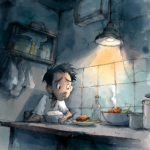
The vinegar clings to the curve. Thin as water, sharp on the nose. Salted egg leans into sourness. Tomato slices fold over each other, seeds spilling slightly. The pako lies green as river moss, fronds still curled at the ends.
She presses her hand lightly onto the bowl. “Don’t stir too hard,” she says. “You’ll tear the younger ones.”
The salad sits in a low enamel bowl, one chip on the rim, rust forming at the edge. No cold plate. No garnish. Just the bundle of forest and memory—gathered, snapped, rinsed, served.
“You rinse in spring water,” she adds. “Only that. Nothing else makes it sing.”
Outside her carinderia, the air carries the scent of rain drying on stone. Inside, the vinegar opens the throat.
“Mid-curl,” she continues, lifting a stem between thumb and finger. “That’s how you know. Before the leaf widens. After the hook forms. That’s when they taste clean. After that, it’s already string.”
She tells me her cousin used to gather. “Near the bend. Where the banana trunk leans. That’s gone now. Fenced.” The fence, she says, stands next to the new water tank—hella tall, thick legs, painted with a resort name.
Before that came, everything could be passed through. Her phrase. Passed through. “You never stayed long in one place,” she says, “but you knew where to step.”
I gesture toward the photo on her counter. “That new way of selling?”
She doesn’t answer. Just taps her nail against the bowl’s rim.
“No one taught you. You just went. If you watched well, you learned. If you were careless, you scratched your legs on the stalks or came home with nothing.”
The old rule was simple: only pick what you’ll use today. “Maybe one for salabat on the way back. But never a basketful unless someone’s sick or it’s a wedding.”
When she was young, she says, pako was never at the table every day. It appeared when someone remembered the way. It never lasted above the stove. “We had no chiller then,” she chuckles, “and if you left it too long, it blackened before morning.”
Customers now ask if hers is “organic.” She presses her lips. “Everything used to be. But we never said it. Because there was nothing else to compare it with.”
The shift happened slow. One eucalyptus tree, then a gate, then a new road. The spring that once cooled the baskets now runs under concrete. “The children still run,” she says, “but no one brings bundles back.”
She shows me how to trim pako. “You pinch and twist. Some use scissors—tourists love the look. But it bruises under metal.”
Down the hill, a Saturday market turns. Stalls set up with folding tables and tall glass chillers. There’s pako here too, coiled tightly in cling wrap. Ten stems, equal length. Darker green than hers. A printed label: “Mountain Forest Greens – Authentic Gathered Heritage.”
The seller doesn’t gather it. “Comes from upland partners,” he says. When pressed, he adds, “Somewhere in Quezon. We get boxes. We do the washing.”
Behind him, a laminated display menu shows the salad: ferns crisscrossed with cured yolk, microgreens, vinaigrette served from tiny droppers. “Upscale now,” he grins. “Eat with fish roe and truffle oil. Chef charges ₱620.”
She had once been invited to supply. “They asked me if I could batch it—half a kilo, pre-packed. Delivered by 7AM.” She laughed once at that memory, then stopped.
“You cannot force the fern,” she said. “If it rains heavy, it won’t speak the way it should. If the sun gets hot too early, the tips burn and curl away. The forest decides.”
She shakes her head. “But they want it year-round.”
Another man tells me about a gathering trip arranged for ‘content.’ “Tiktoker types,” he says. “They were shown the river, made to pick three fronds, and then driven back out. Didn’t wait for the steaming.”
He gestures at one faded sign: “Eco-heritage experience ₱999.” Ferns included in the meal.
Somewhere between the root and the recipe, a line has broken. The knowledge hasn’t disappeared—but it’s no longer required. You don’t need to know how the hook forms. You just need the bundle, clean and sealed, resting against crushed ice. In the video loop above the café counter, a plated version turns slowly under soft light, drizzled with imported oil.
“What about all this,” I ask, nodding toward the reel behind the weekend stall.
She doesn’t lift her gaze. Just runs her finger across the enamel’s chipped edge.
“Maybe it was always going this way,” she mutters.
A breeze lifts the tarp corner. Something clatters outside—maybe a basin.
The salad sits mostly eaten. Only two fronds remain—one shorter, one full-length. They cling slightly to the oil and sourness, but they still hold shape.
She doesn’t dip the last one. Just crushes the stem a little and eats it plain.
I’ve seen it elsewhere—pressed flat inside sushi rolls, or mixed into pesto like an herb. None of it tasted like this.
The enamel bowl sits warm. Empty now—just some vinegar puddled at the bottom. She doesn’t clean it right away. Just lets the smell linger a little longer.