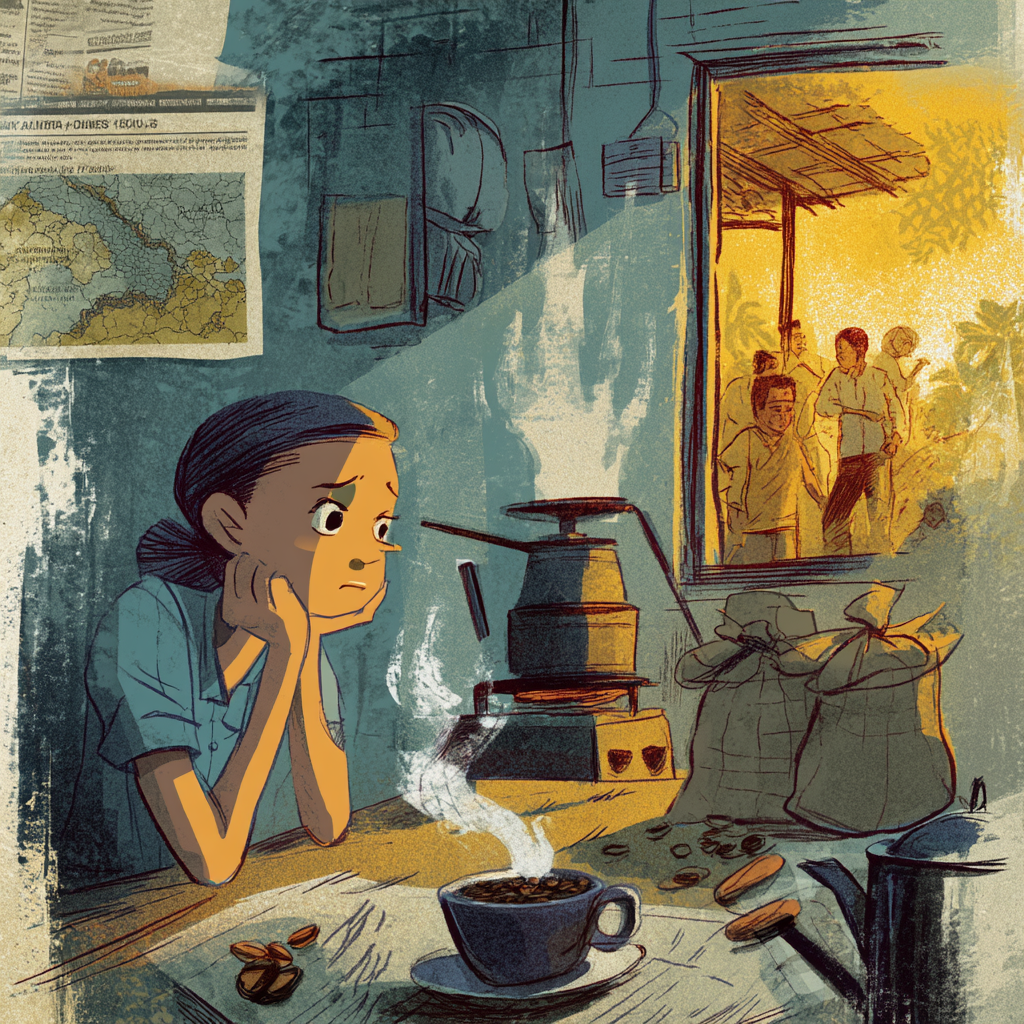

I look at the clock first. It is barely five and the air in Batangas already feels heavy, like late morning in another decade. On the stove a dented kalan holds a blackened pot, the smell of kapeng barako filling the small kitchen. My aunt stirs the brew and says, almost to herself, that the beans once came from trees near the highway. Now the label still says Philippine coffee, but the beans ride down from higher ground.
She tells the story the way elders retell the same jokes. Once, Lipa stood proud as coffee capital, its barako trees taller than houses, branches heavy enough to lean a childhood against. Records trace this Coffea liberica to the 1800s, a rare variety planted in Batangas and later known through the country as a strong, almost feral brew. The tree, and the men who drank it, carried the word barako like a chest pushed out.
In the past decade, maps of Philippine coffee have started to look thinner. As heat builds and rain comes at the wrong time, farmers lose pockets of land where the trees once did well. Some studies even estimate a loss of roughly a third of present coffee areas by mid-century. On paper the numbers sit in tidy tables. In the kitchen the same shift tastes like thin coffee and smaller harvests.
Elevation has always shaped coffee. Arabica likes cooler air, often above a thousand meters, while Liberica and Robusta tolerate more heat in lower sites. Global studies show that areas near the equator below that highland band lose suitability first once average temperatures push up. On Philippine maps this line cuts across familiar provinces. The old coffee belt that hugged low and mid slopes begins to fray at the edges.
In Benguet, older farmers remember mornings when mist sat on the terraces longer. Now their talk turns to flowers opening before the rains, to cherries reddening in patches, to borers that no longer die back during the old cold months. A survey in Benguet lists the same fears in numbers: more than half of those interviewed report smaller harvests, and most say the air feels warmer than when they were young. For highland Philippine coffee, the sky feels nearer yet less forgiving.
On the other side of this story, barako growers in Batangas face the heat from below. Many of their farms sit at low to mid elevations where long dry spells stress the trees and sudden heavy rains wash away flowers. Climate maps for coffee in other tropical countries sketch a similar change. Lowland plots fall out of the suitable range first. The cooler band moves higher and grows thinner on the page. Farmers who once pruned trees by the roadside now talk about relatives tending newer stands in cooler barangay.
The map redraws itself through loss as well as movement. People in the Cordillera still mention Ompong from 2018. They point to a hill and say the wind took the trees there, like it grabbed whatever it found. Coffee trees lay broken with the pines, roots in the air. After a storm like this, a farmer does not lose only wood and leaves. Years of patient pruning and waiting lie on the ground as well. Heat squeezes from below, wind from above. In between stands a farmer with a borrowed chainsaw, trying to decide whether to replant or shift to another tree.
Government roadmaps speak in steady language about productivity targets, value chains, and the old dream of self-sufficiency in Philippine coffee. On the ground, choices look rougher. Some lowland barako growers graft Liberica onto hardier rootstock and hope for a few more seasons. Others replace coffee with cacao, dragon fruit, or houses for rent. In places where land prices rise faster than beans, the strongest pressure does not come from heat but from subdivision markers and warehouse walls.
Higher up, new frontiers glimmer. Specialty buyers look for heirloom Arabica in Benguet and other Cordillera provinces, and social enterprises present coffee as a path to rural pride and income. Yet as climate projections compress the band of ideal conditions, these same highland communities shoulder the risk of planting on steeper slopes, closer to forest margins. Each new seedling on a ridge extends the reach of Philippine coffee, and also the tension between conservation, ancestral land, and cash needs.
The phrase kapeng barako still sells an image of the Batangueño farmer, wide-brimmed hat against sun, rows of glossy leaves behind him. In truth, more beans for local blends arrive from Mindanao or from abroad, while Liberica remains a fragile sliver of total national production. The cup in a Metro Manila café that advertises heritage barako might hold beans grown at higher Batangas elevations, mixed with others from distant hills, roasted to recall an older taste.
This split between label and land sits near the heart of the new geography of food. When we say Philippine coffee, what do we name: species, flavor, farmer, or place where the plant sinks its roots. Heat pushes cultivation upslope. Storms rip through established groves. Markets pull beans along ports and highways until origin blurs. The story still leans on Batangas and Benguet, yet the physical coffee moves in routes that shrug off the neat provincial labels on brochures.
In my aunt’s kitchen the map feels simpler. She tips grounds into the strainer, then pours the dark liquid into chipped cups. For a few seconds she drinks in silence. She has heard of climate change on the radio and from nephews who work in Manila. Later, after strong storms, relief workers use the same phrase. Her measure stays simple. She counts how many sacks leave the barangay each harvest. She thinks about longer walks to the remaining trees, and about blossoms that fall before fruit forms.
When she lifts the pot for a last refill, steam rises with a smell that feels layered. Some of it belongs to lowland memory. Some comes from newer trees higher up, planted almost as a test. The phrase Philippine coffee still carries an older geography shaped by history and trade. The liquid in our cups no longer fits that clean map, it follows newer contour lines etched by heat and by risk. We drink and talk about the weather. Underneath the small talk sits a quiet question about where the coffee will still grow next.