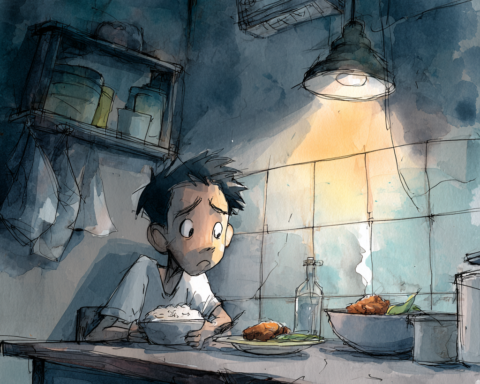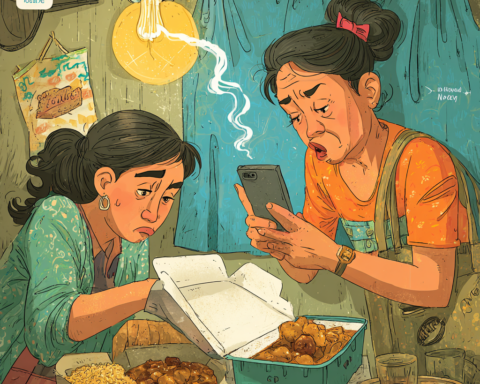
Steam from the rice pot clouds the plastic menu taped to the glass. Inside the carinderia, sunlight lands on the metal trays and leaves the corners dim. A fan turns above the calendar with its pale saints. The air holds the sharp edge of patis.
A poster hangs on one nail beside the price list. The paper curls where grease has touched it. The poster prints a plate at the center. A glass of water sits near the rim.
Below it, two small saucers wait for sawsawan. One holds patis. Another holds toyo. The rims carry old scratches from spoons that have scraped for years. A damp rag hangs from a hook. It smells of soap and yesterday’s heat.
The woman behind the counter catches my stare. Her palm rests on the rice paddle. She nudges the poster with the back of her hand.
“Pinggang Pinoy,” she says. “From the health center.”
Her voice stays even. It has the tone of public things. She presses rice into a mound and smooths the top with one quick turn. The scoop makes a soft sound against the pot.
On the table near the coins, a notebook lies open. The pages carry recipes in two inks. Careful loops fill one line. A second hand leaves hurried strokes. A stain marks the margin where broth once ran. A tin of coins holds the pages down. The paper smells faintly of vinegar and smoke.
“Kay lola,” the vendor says when she catches me looking. “I copy what I can.”
Near the trays, a customer in a sleeveless shirt leans in. His voice stays low. The clinic sits in the words.
“Less salt,” he tells her. “The nurse said my blood pressure is mataas.”
The vendor nods and takes a small fish with the tongs. The fish lands on paper. Her fingers fold the paper into a tight packet, and the smell stays inside the fold.
When my turn comes, I ask for soup. The vendor lifts the lid. Steam rises at once. Ginger moves through the air, clean and warm. The broth looks pale against the dark pot.
At the side table, a woman eats with a laminated ID at her neck. Her spoon stays steady in her hand. From the counter, the vendor calls to her.
“Ma’am dietitian,” she says. The title comes out easy.
The woman looks up with a small smile. Her spoon makes a light knock on the bowl.
“Your tinola tastes right today,” she says. “Light on patis.”
The vendor lifts one shoulder. “People come here for taste,” she replies. Her eyes go to the rice pot. They return to the line.
The dietitian looks at the poster. Her eyes move from the plate to the trays, careful and exact.
“They teach this plate in the barangay,” she says. “Half for gulay and fruit.”
She does not raise her voice. She says it the way one repeats a bus route.
From under the counter, the vendor pulls a tray of sautéed greens. Garlic stays caught in the leaves. Oil glints at the edges.
“I cook gulay,” she says. “Every day.”
Fingers rest on the tray rim for a beat. The voice softens.
“My lola cooked greens too,” she adds. “She cooked what the season gave.”
The dietitian nods. She pulls her chair a little closer.
“Salt hides,” she says. “It sits in sauces.”
A small sound comes from the vendor. She takes a reused bottle from the shelf. In the light, the liquid turns amber. She puts the bottle on the counter, plain to the eye.
“Patis,” she says. “This one does the salting.”
The dietitian looks at the bottle. Her face stays gentle.
“One spoon is strong,” she says. “People forget the spoon.”
In the doorway, a man stops to study the poster. His eyes travel over the plate. One finger draws a line in the air, then drops. He reaches the counter and orders rice with fried pork. His hand shifts toward the greens.
“Add that,” he says.
The vendor nods and serves him. She sets the greens beside the pork, leaving space on the plate.
The dietitian watches the plate slide across the counter. She turns to the vendor with a look that holds respect.
“You do the picture,” she says, and her chin tips toward the poster.
A small laugh escapes the vendor. Her palm brushes her apron. Her eyes go to the crate of kalamansi near the door.
“Sour helps,” she says. “Sour costs.”
The dietitian looks at the kalamansi. She nods once.
“Use sour,” she says. “Use herbs.”
The man in the sleeveless shirt takes the window table and eats at a measured pace. His hand goes near the small dish of fish sauce. The dish slides away a few centimeters under his fingertips.
The vendor watches him for a second. Her thumb touches a page corner in the notebook that has gone soft from use.
“My lola tasted,” she says, speaking more to the room than to the dietitian. “She watched who ate.”
The dietitian sets her spoon down. She nods as if she recognizes a method.
“That is care,” she says. “Care also counts.”
I eat my soup. The fan keeps turning. The ginger warms my throat. I add a drop of patis from the bottle on my table, and my hand stops there.
Outside, tricycles idle at the curb. A mother passes with a child on her hip. The child leans toward the smell of rice.
Inside, the vendor wipes the counter with a cloth. The dietitian stands. Her chair scrapes back on the floor. Her ID swings against her blouse.
Before she leaves, she points at the tray of greens.
“Keep that in front,” she says. “Eyes learn first.”
The vendor nods once. She lifts the pot lid back into place. Steam finds the small gap at the edge, and the poster beside the calendar flutters on its single nail.