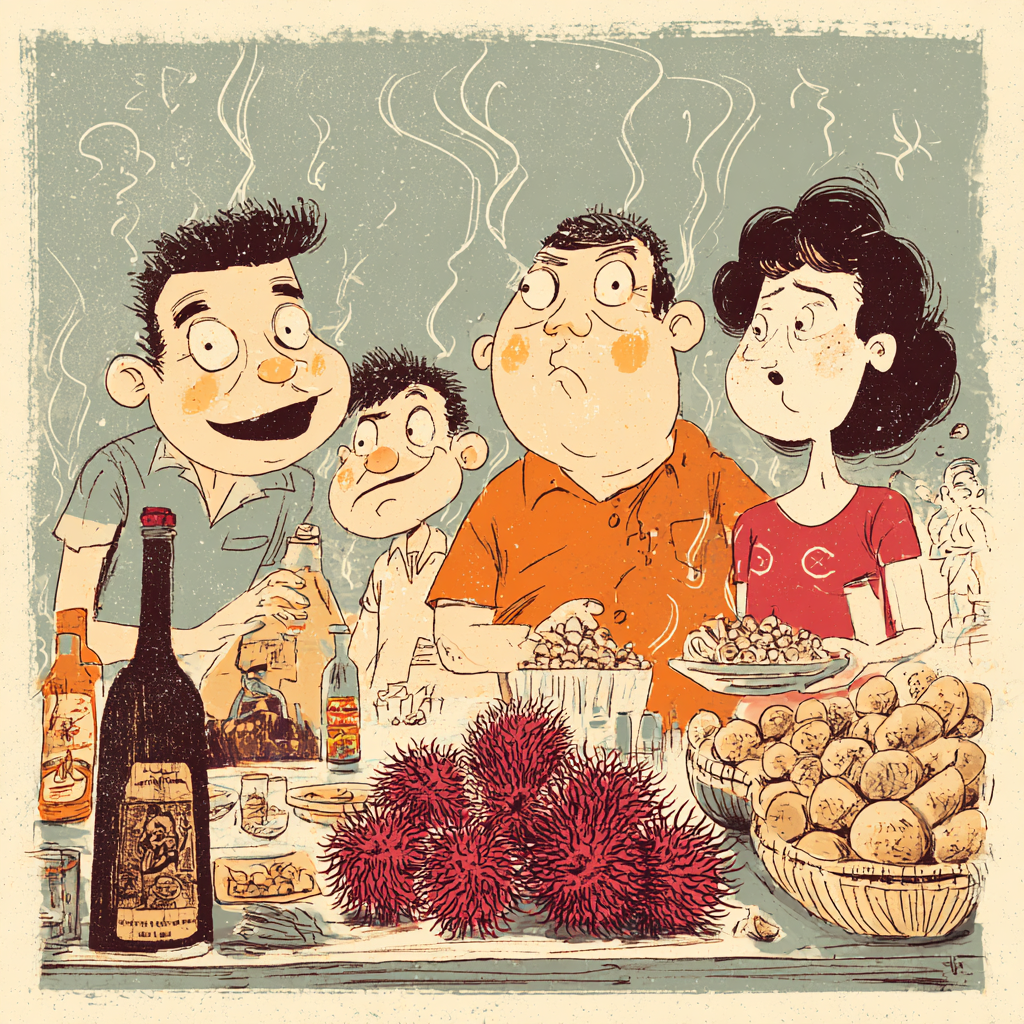
The fruit vendor keeps her rambutan in a shallow basin lined with old newsprint. Ink lingers in the paper when damp. A thin sweetness rides the air, mixed with crushed leaves; with her thumbnail she snaps one fruit open, and the skin gives with a dry crackle, brittle as cellophane.
“Kalahati,” I say, half a kilo. Weighing by hand first, she reaches for the scale, the metal pan already sticky with sap. The chilled flesh slips on my tongue. Her eyes stay on my face, waiting for the season’s answer.
On her table sits a saucer of salt, speckled with red siling labuyo. Some buyers dip the fruit there before they walk away, salt on fingertips. She says sweetness shows itself after something sharp.
“Mas maganda dati,” she says, not as complaint, more like a fact she carries. The flowers came late, she tells me, so the clusters thinned. The supplier who drives through the night with fruit stacked under woven mats talks about heat that dries blossoms before they hold. He mentions fewer bees the way you mention fewer fish: a change you notice after you stop expecting abundance.
At her stall, “bee” is a small word with a large shadow. Then her knuckle raps the basin, quick as punctuation. “Walang bubuyog, walang bunga.” No bees, no fruit. She says it the way someone says no fire, no coffee. Food begins elsewhere.
On the next table, a woman sells bottles of pulot so dark it passes for weak coffee. The label reads lukot. A squat wooden box sits beside the bottles, its tiny entrance sealed with resin. Insects move in and out with the pace of workers who have no time for spectacle.
The honey seller turns a bottle toward the light. “Hindi kasing tamis ng pulot pukyutan,” she says. This one has a sour edge, a small ferment, the taste of fruit that wants to become vinegar.
I buy a bottle, then ask what lukot means. She names the stingless bees her cousin keeps near coconuts and backyard citrus. They fit in a palm. She holds her fingers close together, measuring a creature by air. “Sila ang kusinero na hindi nakikita,” she adds. The unseen cook.
At home, the bottle waits on the table. A warmed slice of ripe saba does the asking. I tip a little pulot onto it. It sinks into the banana’s pores. The first taste arrives gentle, then the tang. The fruit feels newly awake.
Back in the palengke, the fruit vendor has shifted to lanzones, the pale skin bruising under careless hands. She presses each cluster the way you check a baby’s forehead. A customer asks for the sweetest. She chooses by weight and by scent, watching for the faint latex at the stem.
“Sa puno pa lang, alam mo na kung masarap,” she says. You can tell at the tree if it will have flavor.
“Do bees touch lanzones blossoms the way they do other flowers?” I ask. She shrugs, chin tipping toward the honey bottles across the aisle. “Tanungin mo si ate. Sila ang nagaalaga ng bubuyog.” For her, bees belong to honey. Fruit belongs to buyers. Her work is the handoff.
So I cross the aisle and sit on a low bench while the honey seller shows me the box. She opens the lid and points, careful not to breathe too hard over the colony. Inside, resin and wax make a dark architecture, pots like small grapes holding honey or pollen, and the air bites sharp like crushed herbs.
A man in rubber slippers edges in beside the bench, nodding toward the box as if it were an old acquaintance. He keeps lukot for his trees, he says, not only for honey. He has a small orchard behind his house, rambutan for the season, then jackfruit when the heat turns. He learned to split colonies from a cousin in Bicol, and he learned, too, what makes them leave.
“Kapag may spray,” he says. No brands. No curses. His hand makes a small motion, as if shaking water off fingers. After a spray, he sees fewer bees returning to the entrance. He watches the air around the box the way you watch the sky for rain.
He tells me about a training at the municipal hall, where a poster from an agriculture office claimed that more than three-quarters of food crops depend, in some way, on animal pollination, a statistic that sat in the room like a warning you cannot smell.
“Akala ko dati, para lang sa bulaklak,” he admits. He thought bees were only for flowers.
When he says bulaklak, the fruit vendor’s stall returns to mind, blossoms turning into weight and price, the bag now warming at my side; in her basin it means fruit piled to the rim or a scatter against newsprint.
The honey seller speaks of her mother, who once brought home stingless bee honey wrapped in paper after harvest, a small lump bought from a farmer. It was for sickness more than indulgence. In warm water with calamansi, it became gamot for a sore throat. The mother did not keep bees. She knew which neighbor did.
Now the honey sits beside kakanin in the market, sold in 250-milliliter bottles with handwritten dates. A teenager buys one and asks if it can go into a smoothie. The honey seller nods. She does not lecture. She lets new habits form on their own.
Outside, in the late morning heat, the fruit vendor fans flies away from the cut fruit with a piece of cardboard. She ties my bag and slips a few extra rambutan in, not as gift, more like maintaining a relationship. “Para sa merienda,” she says, and the word sits in my palm with the extra fruit, warm through the plastic.
At the corner, a small bee circles the rim of the honey bottle in my hand, drawn to the smell, touching down for a beat before lifting into the street’s moving air. The vendor calls out prices. Coins clink. The basin of fruit waits, bright skins catching sun, each one carrying a quiet labor that never reaches the receipt.