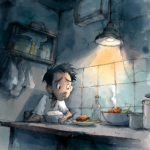
The woman tears the corner with her teeth. The foil doesn’t cut her lip anymore. A callus formed there, small and white, on the inside where the edge passes every morning.
Silver foil. Instant coffee. She dumps it in cold water and stirs. The kettle broke three months ago.
She drinks standing. The laundry waits. Her daughter’s uniform needs washing. The rice needs cooking. She owes the neighbor five pesos.
Lorna. Forty-three. Looks fifty. Everyone in this neighborhood looks a decade older.
I ask about the jar. Why not buy the big one?
“The jar is one hundred fifty pesos. I don’t have one hundred fifty pesos today.”
She has ten. Tomorrow another ten. The day after, ten more. But they never become one fifty. Rice consumes them before they accumulate. Detergent. Her daughter’s allowance. Borrowed pesos repaid.
Two hundred a month on coffee sachets. The jar costs one fifty and lasts six weeks. She knows.
“You think I’m stupid.”
The sachet exists for people who can’t accumulate money. People whose future is always one day away.
She laughs. Sounds like crying with a closed mouth.
“My mother had a jar. Big one. Nescafé. Red label. She’d spoon it out every morning. The smell was richer.”
I wait.
“When it was empty, she kept buttons in it. Different colors. I’d sort them when I was small.”
The callus on her lip. Her mother’s jar. The buttons. Then and now.
Sachets pile in the corner of her kitchen. Silver mountain catching afternoon light. Almost beautiful if you forget what it means. The garbage collector comes twice a week. The pile proves she’s still here. Still drinking coffee.
The ocean. I saw photos from Mindanao once. Sachets washing up in waves. Silver tide. Lorna grew up near the sea. Different one, but close. Has she seen the photos? I don’t ask.
I ask about the waste.
She laughs. Sharper.
“The environment.” She wipes the counter. The rag is more holes than cloth. “You want me worrying about the ocean when I’m worrying about tomorrow?”
She worries though. I hear it under her words. The ocean. The fish. Her daughter’s future. Whether the world will be livable in thirty years. But worry needs space. She has now, not space.
Ten pesos. The ocean is far. The coffee is here.
I have jars at home. A working kettle. One hundred fifty pesos whenever I need it. Storage space. Time to think about oceans.
The sachet costs ten pesos. That’s the price. The cost is her mother’s jar. The buttons she sorted. The beach she grew up near. Her ability to think past tomorrow. The sachets took those first.
Three in the afternoon. She tears another sachet. Her second cup today. She works nights doing laundry for three households. Ironing. Folding. Midnight she’ll need another one to work. Ten pesos each time.
Marie owns the sari-sari store down the street. Second cousin to Lorna. Cousin enough. Sachets keep her store alive, Marie says.
“I used to stock jars. They’d sit for months. Sachets? Gone by noon.”
Marie isn’t exploiting anyone. Same system, different side of the counter. She buys from a distributor who buys from a wholesaler who buys from companies that did the math. They know how to extract more from poverty. Break products small enough to afford, expensive enough to trap.
Three pesos profit per sachet. Two hundred sold daily. Six hundred pesos sounds like money until you count fourteen hours open, seven days a week. Six hundred keeps the store running, feeds her family, pays rent. Nothing left.
Environmental activists came last year. Young. College-educated. Facts about microplastics. Flyers and suggestions for reusable containers.
Lorna took a flyer. It’s on her refrigerator under a magnet. She reads it sometimes. She agrees. Plastic chokes the ocean. Sachets waste resources. Bulk buying saves money and planet.
She agrees. Then buys another sachet.
Agreement doesn’t pay for rice. Doesn’t fix the kettle. You afford agreement when problems are abstract. Lorna’s problems have addresses.
She knows the activists are right. Knows she’s trapped. Knows sachets cost more. Knows companies profit from her poverty.
She offers me coffee anyway. Smiles at her daughter after school. Helps Marie with heavy boxes. Lives in the trap with more grace than I manage.
The corner pile grows daily. She’ll gather them soon. Bag them. Leave them for collection. Dump, incinerator, ocean maybe. Tomorrow brings more.
Last time I visited, she was tearing a sachet. Same motion. Same callus. Same ten pesos.
“How are you?”
“Still here.”
Not resignation. Not defeat. Endurance. Knowledge of the trap plus the decision to keep living. Keep drinking coffee. Keep washing uniforms. Keep being mother, cousin, person who offers coffee to strangers with rude questions.
Still here. Sachets pile. Ocean fills. Companies profit. Cycle continues.
Lorna tears another corner with her teeth. Right where the callus formed. Where it stopped cutting. Where her body learned to accommodate what won’t change.
That callus. Small. Invisible unless you look close. It tells everything. How many mornings. How many sachets. How many times foil passed the same spot until skin adapted.
Poverty marks bodies in small permanent ways. The callus. Lorna’s automatic hand motion. Standing to drink. Not wanting the jar anymore because wanting hurts.
We all have calluses. Different shapes. Different reasons. We adapted to broken systems. Morning routines unquestioned. Small bargains with convenience. Feelings we trained ourselves not to feel.
Where does the edge pass through your life without you noticing?
Not guilt. Recognition. The kind that makes you check your own lip. Wonder what you adapted to. What buttons you sorted. What jar your mother had. When you stopped expecting it back.
Lorna’s callus shows me mine. Good witnessing does this. Not pity. Connection. Recognition that accommodation is human even when systems aren’t.
She tears foil. You have your version. Daily unquestioned motion. Adaptation repeated until your body protects itself.
Find it. Feel it. Let it connect you to Lorna. Not through pity. Through shared humanity inside systems bigger than us.
Not the sachets. Not the trap.
The callus. Recognition we all grew one somewhere.