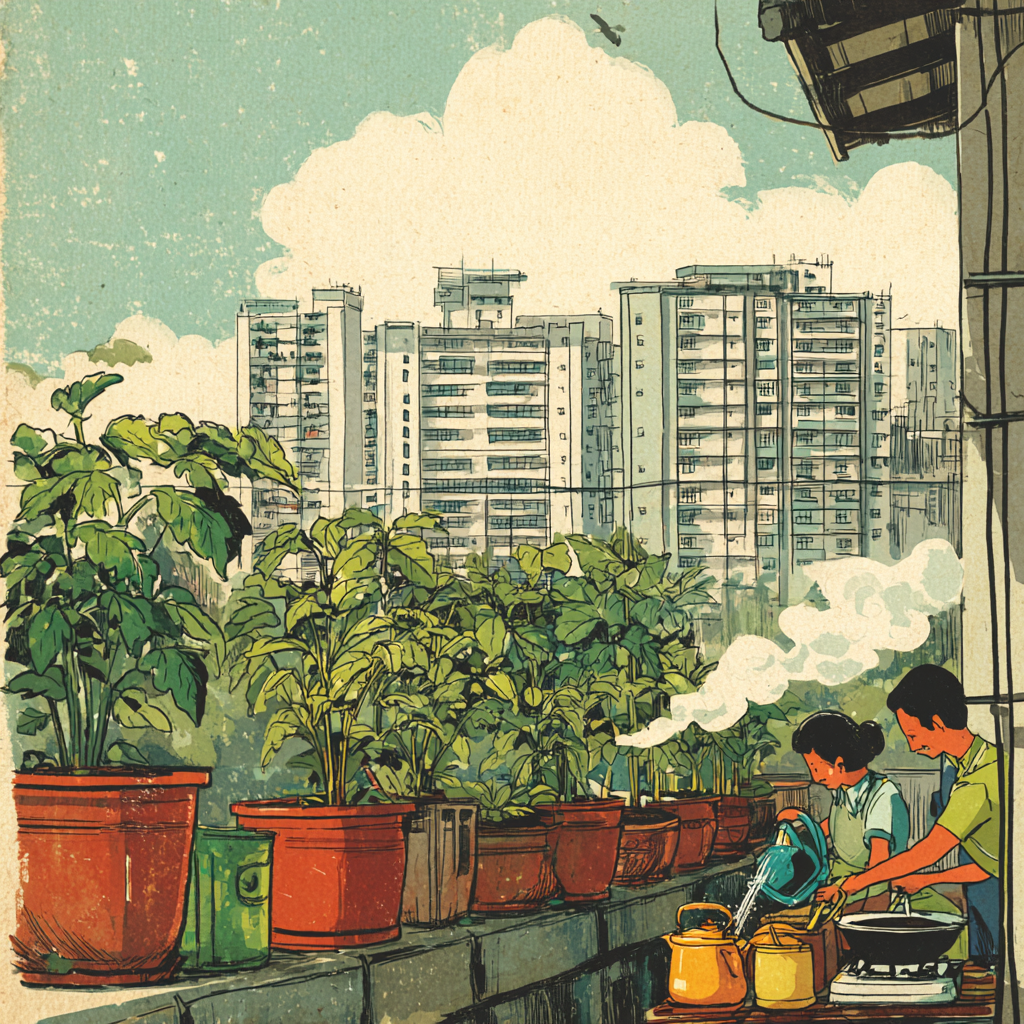
There is always a wind. Not strong, but persistent. It moves across this seventh-floor balcony like it’s searching for something soft to shake. What it finds are leaves—narrow, green, curled slightly at the edge.
The pots they grow in are not really pots. Recycled buckets with peeling stickers. Two old cat food tubs. A styrofoam box once used for fish. Each one filled with loose, dark earth.
She bends at the waist. Holds the edge of one bucket steady with one foot. Her hand moves across the soil surface, brushing it like checking if it remembered to breathe. The tip of her index finger presses into the loam.
“Dry again,” she says. “It always fools you in the morning.”
Another pot is lifted closer to the sun. No dramatics—just adjustment. The plant inside is sili. Still young. The fruits hang low, pale green with a bit of shine. Not yet the kind that burns.
“Pang–gisa lang,” she says. “I don’t wait for red. This already bites.”
She doesn’t mean the serious sting you find in the countryside. Not the sun-scorched labuyo that breaks open just from steam. This is city-grown fire. Smaller, softer, but still sharp if you leave it on your tongue.
We are just above the midlevel of a building that was once fully commercial—offices, retail. Then the upstairs units became homes. Balconies like this one weren’t meant for planting. They barely clear the AC unit. Railings too low, drainage badly sloped. But here, somehow, are six buckets of edible leaves, three sili plants, and a short trough where a single kamatis vine tries its best.
“Started during lockdown,” she explains. “Not dramatic. Just hard to get what I needed.”
She points behind her—past the screen door, into a tight kitchen.
“You make fried rice,” she says. “You want something sharp. Pag walang sili, parang kulang.”
Not always available then. Not always cheap now.
“I don’t use every day,” she adds, tugging slightly at a stalk putting out new leaf. “But when I do need one, and it’s here—iba talaga.”
From here I can see four other balconies. Most hold laundry. Plastic chairs. Storage bins. One has a drying rack with old puppet heads wired to the bar. One has nothing at all. But down to the right, just barely visible through clothes hung to dry, I spot basil.
“May nagtatanim din diyan,” she says. “Nag-uusap kami minsan. Her husband makes pesto. She doesn’t even like it. Just wants to keep something green.”
She goes inside for water. When she returns, she’s carrying a repurposed cooking oil bottle. The label half-rubbed off. The cap pierced with four small holes. She uses it like a watering can, careful and slow—the sound a soft trickle onto dry earth.
Up north, just across Kalayaan Avenue, a man has mounted black tubes against a wall. Not factory tubes. Just PVC. Sliced open lengthwise, fitted with cotton disks. The leaves inside are wide, deep green, but don’t quite touch each other. He monitors water from a shallow basin. There’s a timer that tells him when to pump again.
“Low-effort lang ito,” he says. “But you still need to listen.”
He doesn’t mean with ears.
I ask what it grows best.
“Kangkong,” he replies, lifting one with two fingers near its base. “You feel it snap? That thickness—just right for cooking.”
He cuts a bunch quickly, bundles it with scrap twine, and sets it inside a plastic tub. He doesn’t sell.
“Karinderya sa baba,” he says. “Sometimes they fry fish, and I don’t want to cook. So I bring greens.”
He smiles. “Trade. Old way.”
At the carinderia, the cook receives the bundle without ceremony. She dunks the leaves in a tub of water by her side, shakes them once, and starts chopping. Oil in the pan already. Garlic browning just enough before she adds the greens. No fuss. Just speed.
I ask how often trades happen like that.
“Before? Common. Ngayon—siguro just neighbors who trust.”
She puts a lid over the pan briefly. Opens it. The aroma escapes. Soy sauce follows. The leaves darken.
She plates it without garnish.
When I taste it, I understand. The stems keep a little bite. Garlic does all the talking. Salt comes low and steady. The greens finish soft, but not limp. They don’t beg for protein beside them. They don’t need sweet, sour, or crunch to balance.
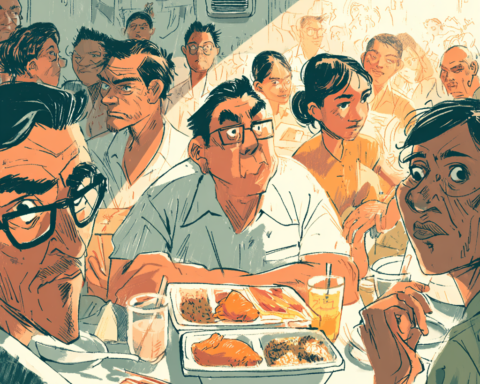
The man beside me—lean, probably early sixties—says nothing until he finishes his spoonful.
“Galing sa taas ‘yan,” he says, nodding toward the building. “Tapat ng hagdan.”
Then, after a pause: “You can taste if something came near cement or near soil. Don’t know how. But you know.”
The cook laughs. “Luto lang ‘yan.”
He shrugs. Keeps eating.
Back at the balcony, the sun has begun to shift. The plants lean with it. Not dramatically. Just enough.
“I rotate them twice a day,” she says, turning one of the shallow pots a quarter angle. “They’re stubborn, pero they follow if you guide them early.”
She doesn’t expect yields. Says she gets four or five fruits at a time. Enough to jar in vinegar. Enough to float in broth. Once she fried all six in a bit of oil, crushed garlic into the pan, added leftover rice, and stirred until the smell felt like company.
I ask if she’s trying anything new.
“Maybe pechay,” she says. Then shrugs. “But I heard it wilts fast if you don’t give love.”
She waters again before I go.
There are no signs. No triumph. The plants don’t look impressive if you don’t know what they’re for. They’re not trimmed to be pretty. They’re leaned, patched, recovering—sometimes even thriving.
The balcony smells stronger now. Not floral. Not sweet.
Just alive.