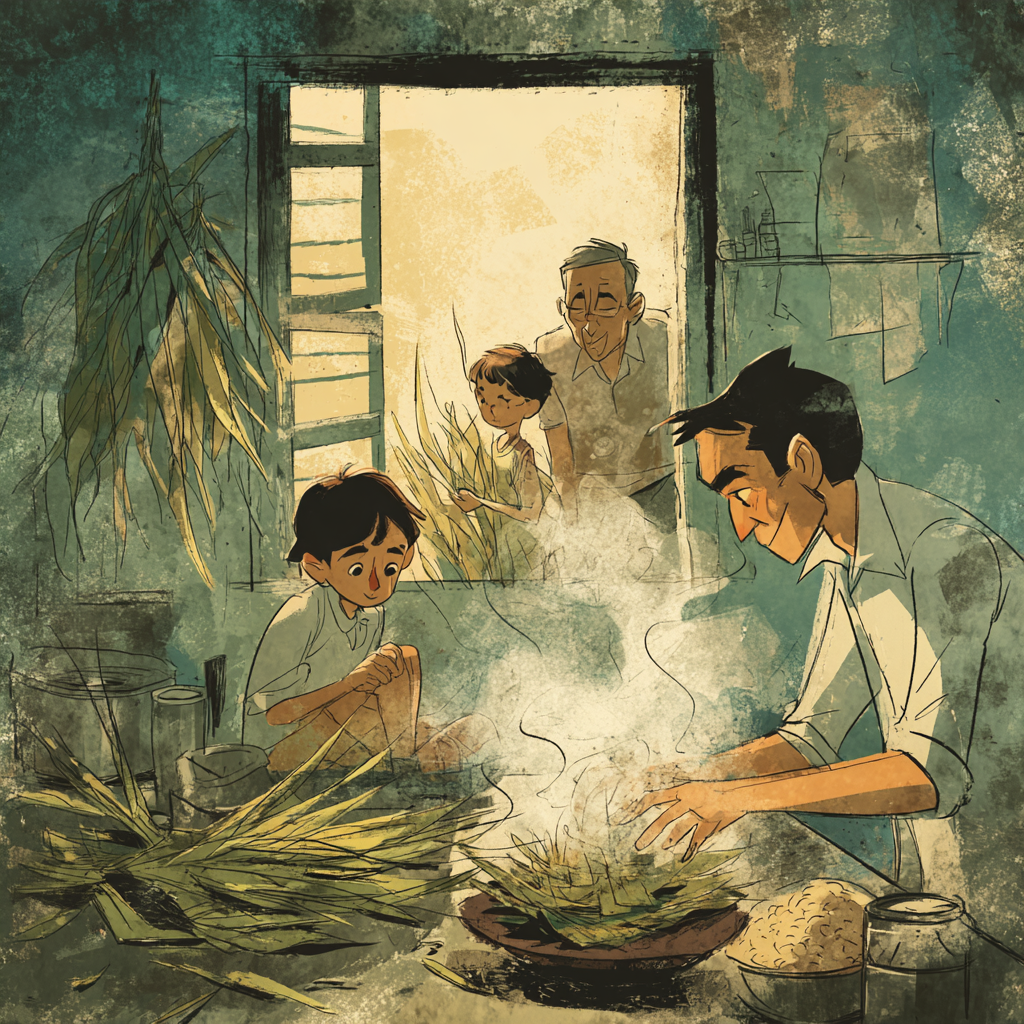
Steam lifts from the cooked grain like sighs in the morning air. She undoes the twine holding the banana leaf wrap, fingers steady despite the heat. Inside, the off-white grains glisten faintly, swelling like kakanin but coarser, without the cling of glutinous rice. She calls it simple: “Adlai lang. Pero busog.”
We’re sitting on a low bamboo bench behind her sari-sari store. She doesn’t sell this from the shelf, only to neighbors who ask, or to people she knows won’t complain at the price. She scoops some into a shallow plastic plate and hands it over.
“Try mo. Mainit pa.”
It tastes nutty. Slight chew. Heavier than rice, lighter than corn. She’s mixed it with flaked tinapa and thin strips of pakô, all dressed in calamansi. Nothing showy. But it fills the plate with the kind of calm that usually only comes after soup.
She shrugs. “Walang ulan sa taas. Di na kaya ng palay eh.”
She means a field in the uplands, not far from where the cement ends. Her cousin brought the seeds down two years ago, said people in Bukidnon were planting adlai again. Not many. Just enough to keep the soil from cracking open.
The muscle memory of planting came back easily, she says. The waiting took longer. “Mas matagal siya sa palay. Pero kahit hindi umulan, may aanihin ka.”
The whole barangay still eats rice, of course. Cheap NFA sacks delivered every month. But if it’s too hot, if the irrigation pipes clog or the truck can’t pass through after a storm, people remember this grain she unwraps like something borrowed from before the highways—before racks of instant noodles and flavored vinegar made it hard to remember what came first.
She didn’t grow up with adlai. “Sa amin noon, kamote. Ubi. Kahit gabi minsan. Pero ito,” she gestures back at the plate, “ginagamit na ng anak ko pag may research. Climate something.”
That “something” has a way of slipping into her stories now. She says she doesn’t understand the science—only that the land gives less than it used to. Some neighbors say the rain forgot the path to their rice fields. They still plant, out of habit or hope. But more and more, they slip in root crops along the edge. For insurance. For old times’ sake. For whatever is coming.
She reaches for a tub of ubi halaya, cooling in the shade. The color is deep, almost blue, stiffened at the edges. “Yan, panay sa baha. Pero pag tagtuyot, tumatagal. Galing Bohol daw.” She lowers her voice, not secretive, just steady. “Pero kung totoo man, hindi ko alam. Dati, galing lang ‘to sa likod bahay.”
She remembers her lola digging the ubi up after months underground. Brushing off the red dirt. Letting the tubers breathe under the kamalig steps for two nights before boiling. “Hindi pang bisita ’yon. Pang bahay lang. Masarap kung may asukal. Kung wala, asin.”
Now it’s December when ubi returns in bulk, a signal for Christmas sweets. Wrapped in cellophane or stacked in glass jars, smiling logos stamped with “Artisanal” in cursive. A far cry from the crumbling tablea tins in which her mother stored mashed yam topped with latik. But the flesh is the same. Soft, earth-heavy, forgiving in dry months and more generous than it looks.
I ask if people in her barangay plant it still. She shakes her head.
“Wala nang lupang pag tataniman. Pero kung gusto mo, may nagtitinda. Galing Bicol daw.”
Someone once tried to sell her kids on sweet potato fries. “Pero pag pinitik mo ‘yong regular kamote sa mantika, pareho lang—mas mura pa.”
She doesn’t say this to scorn change. Only to mark the point where memory runs into trend.
She turns back to the adlai. “Kaya lang ito nagsimulang itanim ulit kasi kailangan. Hindi kasi ito uso. Hindi rin siya sikat.”
I ask if it grows fast.
“Hindi. Matagal.”
The spoon she uses is scratched metal, inherited with no ceremony. And when she eats, her hands cup the plate like it might cool faster that way. Tiny gestures carried from years of feeding without thinking, without explaining.
She stops to think. “Tay ko, minsan kwento niya ’pag panahon daw ng digmaan, ’yong mga ugat ng gabi at ubi, nakatago sa ilalim ng lupa. ’Pag wala nang laman ang bayong, dun sila kumakain.”
She chuckles. “Ngayon, may sticker na ‘superfood’.”
Coins clink behind the curtain. A boy asks for a sachet of coffee. Her daughter peeks out, says the delivery truck passed early. No rice today.
“May lumang tugi pa yata ako.”
She squats down, opens the drawer. Old clothespins roll to the side. Receipts curled like straw. A coin wrapped tight in cellophane sits at the bottom.
“Wala na nga lang nagpapakulo.”
Morning keeps going. Clothes hang limp from the line. The ubi goes back under the bench, still cool. The adlai remains, barely warm but still filling the plate.
“Ubos na bigas sa palengke,” she says. Then quieter: “Pero may remedyo yan.”
And that is enough—for now.